
Last Updated on April 4, 2026 by teamtfl
“The most dangerous words in investing are: this time it’s different.” — John Templeton
Your LIC agent called it a smart investment. One premium, insurance plus savings, tax benefit under 80C. The perfect product for someone who just received a lump sum — a bonus, a gratuity, a PF withdrawal.
Here is what they did not tell you.
The actual return on LIC Single Premium Endowment Plan — after accounting for real bonus rates, the cost of embedded insurance, and now the 2023 Budget tax change — is somewhere between 4.5 and 5.5% per annum for most investors. That is below inflation. That is below SCSS. That is below a simple bank FD for senior citizens.
And since April 2023, if your single premium exceeded Rs 5 lakh, your maturity proceeds are fully taxable. The one tax advantage this product was sold on — gone.
This review will show you exactly why this product fails on both counts it promises — protection and investment.
⚡ Quick Answer
LIC Single Premium Endowment Plan (Plan 917) is a non-linked, participating endowment plan. Pay once, get insurance cover plus savings over 10 to 25 years. The real IRR is approximately 4.5 to 5.5% — well below what alternatives like PPF, ELSS, or even SCSS can deliver. Since Budget 2023, single premium policies with premium above Rs 5 lakh have lost their Section 10(10D) tax-free maturity status. Our verdict: the plan fails on both protection and investment. A term plan plus PPF or mutual fund SIP is a far superior combination for the same money.

What Is LIC Single Premium Endowment Plan (Plan 917)?
LIC Single Premium Endowment Plan is a non-linked, participating, individual life assurance savings plan. You pay a single lump sum premium at the start. In return, LIC provides two things: life cover for the policy term, and a maturity benefit at the end of the term (sum assured + bonuses if you survive).
The plan has gone through several versions. The original reviewed here in 2014 was Table 817. The current active version is Plan 917 (UIN 512N283V03). The structure is the same — the numbers are slightly worse.
- Entry age: 90 days to 65 years
- Policy term: 10 to 25 years (maximum maturity age 75 years)
- Minimum sum assured: Rs 50,000; no upper limit
- Premium: single lump sum payment at start
- Loan: available after 1 year; up to 90% of surrender value
- Surrender: first year — 75% of premium; after first year — 90% of premium
- Riders: Accidental Death and Disability Benefit and Term Assurance Rider available
The plan participates in LIC’s profits, earning Simple Reversionary Bonus each year plus Final Addition Bonus at maturity or death. But as we will show — this bonus story is not as attractive as it sounds.
The Tax Change Nobody Is Telling Policy Buyers
This is the single most important update to any existing review of this product. Finance Act 2023 removed the Section 10(10D) tax-free exemption on maturity proceeds for life insurance policies where the annual premium exceeds Rs 5 lakh.
For single premium endowment plans, this means: if your single premium paid was more than Rs 5 lakh, your maturity amount is no longer tax-free. It will be taxed as income from other sources at your applicable slab rate. For someone in the 30% bracket, this wipes out a significant portion of already modest returns.
🚨 If you invested more than Rs 5 lakh in a single premium endowment plan after April 1, 2023: Your maturity amount is taxable. The tax-free maturity benefit that agents used as a selling point no longer applies. This change was introduced in Budget 2023 and applies to policies issued on or after April 1, 2023. Policies purchased before this date are not affected. If you are unsure of your policy’s tax status, consult a CA or SEBI-registered advisor before making any decisions.
The original 80C deduction on the premium paid still applies — up to Rs 1.5 lakh limit. But on a single premium of Rs 5 lakh or more, only Rs 1.5 lakh qualifies. The rest earns no deduction and the maturity is also taxable. The tax “efficiency” of this product has collapsed.
The Real Return: What the IRR Actually Says
When LIC sells this plan, they show you a bonus illustration. It looks attractive on paper. Let us break down what you actually earn.
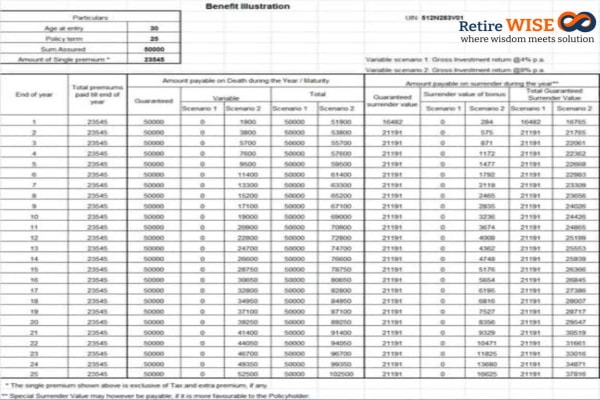
Here is an illustration for a 30-year-old investing in Plan 917 with a 25-year term:
| Parameter | Amount | Notes |
|---|---|---|
| Sum Assured | Rs 1,00,000 | Base cover |
| Single Premium (approx.) | Rs 62,355 | Your one-time payment |
| Estimated maturity (at 8% assumed return) | ~Rs 2,50,000 | Includes sum assured + bonuses |
| Actual IRR | ~5 to 5.5% | Based on current bonus rates |
Illustration based on LIC published premium tables and historical Simple Reversionary Bonus rates. Actual returns depend on LIC’s future bonus declarations, which are not guaranteed.
⚠️ The 8% assumption is misleading: LIC must show illustrations at 4% and 8% assumed investment return. The 8% figure is what LIC would need to earn internally to generate the illustrated maturity amount. This is not what you earn. Your actual return — the IRR on your premium — is approximately 5 to 5.5%. A 25-year PPF earns 7.1% tax-free. A 5-year SCSS earns 8.2% with your principal intact. An ELSS held for 25 years has historically delivered 12 to 15% CAGR.
Now Add Back the Insurance Cost You Are Paying
Here is the deception at the heart of every endowment plan. You are told you are getting insurance plus investment. What you are actually getting is an expensive insurance policy where the premium funds both the cover and the investment — and neither is optimal.
For a 30-year-old, a pure term plan for Rs 1 crore cover costs approximately Rs 8,000 to Rs 12,000 per year. A 25-year single premium term plan would cost roughly Rs 1.5 to Rs 2 lakh.
If instead of buying the LIC Single Premium Endowment Plan, that same person:
- Spent Rs 1.5 lakh on a single premium term plan for Rs 50 lakh cover
- Invested the remaining Rs 60,000+ in a PPF or liquid mutual fund
They would have better insurance coverage, better investment returns, and full liquidity. This is what “keep insurance and investment separate” actually means in practice.
Three Arguments Agents Will Give You — and Why They Fail
Argument 1: Family protection. You need lakhs in cover — ideally Rs 50 lakh to Rs 1 crore for a senior executive. To get Rs 50 lakh cover from an endowment plan, your premium would run into several lakhs. A term plan gives you the same cover for a fraction of the cost. The protection argument simply does not hold up at any realistic coverage level.
Argument 2: Guaranteed returns. The bonuses are not guaranteed. LIC declares them annually based on its surplus. Bonus rates have been declining over the past decade. What was illustrated in 2014 at 6% IRR is now closer to 5% in practice. There is no contractual guarantee on the bonus component — only on the sum assured.
Argument 3: Tax benefit. Section 80C deduction still applies on the premium up to Rs 1.5 lakh. But post-Budget 2023, if your single premium exceeds Rs 5 lakh, maturity proceeds are taxable. For most senior executives making large lump sum investments, the tax exemption on maturity is gone. And 80C space is better used for EPF, PPF, or ELSS — all of which give better returns.
What Should You Do Instead?
| Need | Better Option | Why It Wins |
|---|---|---|
| Life cover | Pure Term Plan | 10x the cover for 1/10th the cost |
| Safe long-term savings | PPF | 7.1% tax-free, sovereign guarantee, 15-year lock-in matches retirement horizon |
| Wealth creation over 10+ years | ELSS / Diversified Equity MF | Historical 12-15% CAGR, LTCG tax-efficient, liquid after 3 years |
| Senior citizen income | SCSS + Debt SWP | 8.2% + flexible withdrawal + principal intact |
| 80C tax saving | ELSS or PPF | Better returns, same or better tax benefit |
The fundamental principle has not changed since 2014. Keep insurance and investment separate. A single premium endowment plan bundles both in a way that optimises neither. You end up with insufficient cover and inadequate returns — two problems instead of zero.
The RetireWise Verdict on LIC Single Premium Endowment Plan
Avoid. The IRR of 4.5 to 5.5% is below inflation and well below what alternatives deliver. The tax advantage on maturity is gone for policies with premium above Rs 5 lakh (post-Budget 2023). The insurance cover provided is expensive relative to pure term plans. If you already hold this policy, do not panic — evaluate surrender value, remaining term, and alternative deployment before making any decision. If you are being sold this product today, the answer is no.
Already Hold This Policy? What to Do
If you bought this plan before April 2023 and your premium was under Rs 5 lakh, your maturity is still tax-free. Sit tight — surrender charges mean you lose value by exiting early. Calculate your remaining term and surrender value before deciding.
If your premium was above Rs 5 lakh and the policy was issued on or after April 1, 2023, your maturity is taxable. In this case, model out the post-tax return carefully against alternatives. For most people in the 30% bracket, it may make more sense to surrender and redeploy — but run the numbers first with a SEBI-registered advisor before acting.
For a comprehensive understanding of how to structure retirement savings across products, read our guide on best investment options for senior citizens in India. And for understanding how insurance and investment interact in retirement planning, see our post on LIC Jeevan Akshay VII — when insurance products make sense.
Have a lump sum to deploy wisely?
At RetireWise, we help senior executives structure lump sum inflows — gratuity, PF, property proceeds — into a layered retirement income plan. Insurance where it belongs. Growth where it belongs.
A product that promises both insurance and investment — and delivers neither adequately — is not a compromise. It is a trap dressed as convenience.
Keep insurance and investment separate. Always.
💬 Your Turn
Have you been sold a single premium endowment plan? Did you know about the 2023 tax change? Share your experience below — your story could help someone avoid the same mistake.
Originally reviewed by Jitendra PS Solanki, CFP & SEBI-registered Investment Adviser. Updated and significantly expanded by Hemant Beniwal, SEBI-registered RIA, to reflect LIC Plan 917, Budget 2023 tax changes, and current 2026 market conditions.
my registration no & member ID is-2768618, I have money trouble and family problem pl cancellation my membership & earliest possible and amount return pl.
Hi Bipin,
I can understand your concern but you have to talk to your agent for this.
Dear Sir,
I have purchase just LIC Single Premium Endowment Plan @ 50000/- for ten years. pl tell me what is the maturity amount or interest rate after 10 years. (Age 40 yrs)
pl reply.
Regards,
Dinesh Kumar
Dear Mr Dinesh,
We can not calculate the exact maturity amount.
Don’t expect more than 4-5% P.A return from endowment plan.
Sir, I want to know.. Which is better, single premium endowment plan or FD, amount 12lacs for 10years. Does the mature value of endowment plan is taxable
Dear Renu,
Never mix your investment with insurance. Insurance is for financial security of family in case of something misshapen.As you want to invest for 10 years you should consider Mutual fund equity funds. This will give you better return than FD in long term.
I want to know if i invest 1 lac for lic single plan for 10 year & on maturity i get 190000 then it cums under long term capital gain or what
Dear Mitesh,
If the sum assured on single premium policy is 1.25 times the premium amount, then the maturity amount will be taxable.
Dear Sir,
I need a clarification for the below:
Rs.30 Lakhs was paid as Jeevan Rekha in 2005 and Rs.50 in 2006 as single premium plan. Now It has been pre matured in January 2015 and got Rs.33 and Rs.55 Lakhs where LIC has deducted TDS @2% on total amounts. Pls advice what will be taxable amount. When it has invested the amount was paid after Taxed Income.
Can a man get the benifits of two accidental lic policy
What is the benefits of two accidental LIC policy for one man
HI ,
thanu here ,my age is 30 , need for pension plan 25 years long term nearly 25,000 quarterly (Without insurances ) can you please advice which plan is best to go ahead for good returns ,please give scenario with sum assured +bonus .. as a common man its bit of confusing around where to put money , would feel happy if you answered..please give chart table without insurances cover
sir i m 58 years old i want to buy this plan 500000 so plz tell me what the sum assured covered and for how much time and maturity time how much amount i will received
dear sir,
my friend resides in USA wants to transfer his pension fund to india to QROPS. Is it possible. If possible what is the procedure. explain
Hi
Apologies for asking this question in a wrong section. But I couldnt find the answer when I searched on your website.
Question:
I am a NRI residing abroad since 6 years and plan to take up the citizenship there.
Am I eligibile to buy any life term insurance plans in India? I am 32 yrs male and plan to take the longest available term plan
( I have one plan in my current country of residence, but I want to buy one in India as well keeping in mind that I will return back in next few years)
Thank you.
Hi Sjn,
Yes, NRIs can take avail a term insurance in India.
HI Ravindra,
In my opinion for Term policy, we should belive the standard product or company. Since its a long term purpose..! Is it now the LIC term Plan is available in market after 1st Jan 2014..?
Regards
Raj Sekhar A
On line Term plan is best for protection. Several reputed groups as well as comparisons are available for private insurance companies. More reputed like SBI Life, HDFC Life, ICICI Pru Life etcIt is low cost due to bypassing middleman (agent). Still you wish to stick to LIC then you can take a LIC Term Plan.
Before taking Term Assurance First review Claim Settlement Ratio.
LIC has rejected only 1.12% of total claims whereas Private Companies have rejected 7.85% of Claims.
Dear Hemant,
Firstly correct your article as you seem to be in a hurry to be the first on to criticize.
In new Jeevan Anand entry age is 9 months and not 90 months. Secondly, you seem to be a great economist who compares everything w.r.t IRR.
Actually there is a term called as pay off. A person has to accept a certain lesser return when he needs advantage of Insurance.
What if a person dies say after 3 yrs after paying 3 premiums. The returns which his family will get returns which are more than any of your suggested ideas.
PPF should not be compare to Insurance. These are completely two different aspects.
PPF is for tax saving and long term savings. Insurance is for Protection, Savings and some decent returns.
Please do not misguide people. You have knowledge and that is great, But please use it for right purpose.
Hi Vicky,
Let me answer your query:
1. First, the product is single premium endowment the details of which is available on LIC website. At no instance Jeevan Anand is mentioned apart from queries of readers.
2. The second and most important is the benefits you have highlighted and I will be elaborating on the same. You have Illustrated two benefits of buying insurance plan:
a. Protection- Here most of us do a mistake when we do not evaluate our actual need of family protection. Put simply we do not know what will be the actual amount required by our family to sustain living if we are not there. I am sure if we do , the amount will be much high because we are trying to replace the income we will generate for our family till our retirement. Why? because that may be the only source for them to manage their expenses and repay liabilities which i may leave for them. So which insurance can give me such a high protection within the savings ability I have.You will also agree that premium in a policy like above or even Jeevan Anand will be out of reach. In my view a term insurance fulfill this requirement of giving a high protection right from the first day of buying it.So if death takes place in three years after taking the insurance, my family get more than decent amount to sustain.
b. Savings- I invest my savings not for dying tomorrow but to accumulate wealth for the goals i want to achieve. So i need investment where I don’t have to pay cost for any other objective and it can give me the returns to reach my destination. I don’t see it happening in traditional insurance plans.
c. Decent Returns- The definition has to be corrected because we have to earn real returns i.e. returns which can beat inflation. If my expenses are increasing by 6% will I be satisfied with 6% in 25 years time or even 10 years time considering i will be at the same position where i have begun. I think one has to answer this question first and then decide on the product.
All the points discussed above are different aspect of our planning and so need to be planned differently. We are no economist but simply evaluating products to see which requirement they can meet.
I hope this will clear any doubts you have on the analysis which is done.
I hope thsi
Dear Mr.Vicky,
Mr. Hemant is absulutely right. He said take term plan for insurance coverage and for investment purpose you have to select other options.
Swapnil
Thank you, Hemant !
You have nicely summarized the pros and cons of the system as a whole ! Congrats !
It is well suited for the risk-averse , conservative seniors !!
Hi Devadoss,
Even the risk averse, conservative seniors will find other alternatives more appropriate. 🙂
Sir, Can u suggest whether i-Guarantee plans launched by some insurance co. are good to go as it contains insurance as well as return.
Dear SSRao,
I have not evaluated this product yet so cannot comment. Will be doing it soon.
Hemant, Asusual one more useful document from you. I have recommended your posts to many of my friends. They are also so happy with me that I have referred a correct path for financial planning and guidance.
Can you share your views on Jeevan Anand Policy bit clearly. I am 27 years old and I have taken 4 years back. I am seeing mixed views on this policy and want to get a clear picture on this.
Amar
Jeevan Anand policy main attraction was accidental insurance and term insurance (50%) even after the maturity of the policy. But it is a traditional plan and so maturity amount you receive is based on the bonus declared in the policy, which is not assured and based on the performance of investments which is majorly into debt.
Dear Solanki,
Jeevan Anand’s risk cover even after maturity is 100% of Sum Assured and not 50% as mentioned.
Dear Somasundaram,
Corrected. In previous version of Jeevan Anand Additional SA was payable on death after the term of the policy.
I am NRI from gulf, we all are covered by an insurance from the company that covers even critical illness like heart attack or long term disability. However, when we return to India after retirement, no one will offer insurance cover at 60 above to cover critical illness or long term disability.
I request you to suggest an insurance plan that we can take it at any age or say before 50 continue paying the premium just to have this cover.
or just let me know if any good insurance policy for the cover of critical illness for the full family of say 4 members- husband and wife and 2 kids.
thanks for your consideration in advance.
Surrender Value affects the costing of the policy. The previous policies were designed as per regulations. The customer purchases a policy seeing the benefts offered to him at the time of purchase i.e. value of his money. Now it is difficult to offer higher surrender value in same cost (premium). So no change in previous contracts. New surrender value clause is applicable for new policies.
One quick query on surrender value of old policies (pre-2014). Would the new surrender value norms apply to those old policies or it is applicable only for new policies issued from 2014?
Venkateswaran,
The new rules applies to policies bought after January 1st, 2014.
Sir plz reply the answer of my question .
I am 33 years now and a having 3.3 yrs daughter. Invested in two different LIC policies and recently taken term plan, need your inputs whether to continue on the same or any change.
LICs:
1) The Money Back Policy – 20 years, premium 31,437/yearly, SA 5L, taken 04/10/2006
2) Jeevan Kishore (on my daughter’s name)- 19 years, premium 25,239/yearly, SA 5.2L, taken 23/11/2011
Term Policy: Aviva iLife – 35 Years, premium 5,590, SA 60L, taken 02/12/2011
Akbari,
Money back policies are the costliest among traditional plans and their returns are below inflation. Jeevan Kishore too is a traditional plan and so the returns will be lower. You should look at other investing options such as PPF and Mutual Funds for meeting your child goals.
Thats clearly visible that single premium policy offered by LIC is not going to benefit customer either way. The major reason for buying insurance policy in last quarter of the year is basically is to avail tax benefit u/s 80C which this policy does not fulfil beacuse of S.A premium ratio. In single premium LIC plan, the customer needs to be aware of the tax implications or he might be mis sold on this front. It is not wise decision to buy this policy only because of returns that are also not very lucrative.
Is is better to purchase a regular premium insurance plan which will suffice the tax benefit need not only for current year but in future years also. Since the sum assure is 10 times of premium paid on high end, the returns are also high in long term as bonuses are declare as a percentage of sum assured. Also for young employed or recently married people this is the best instrument to inculcate good regular saving habit. Regular premium life insurance plan develops a habit of force investment cause you are bound to invest every year if you did it for first the year..
Computation of adequate risk cover is very necessary in current era due to various factors arising because of changing lifestyles. Methods of insurance cover calculation are available with qualified insurance agents. I say qualified because those agents helps the customers to buy the insurance plan by doing their need analysis and establish a long term client – agent relationship unlike many other who only knows how to sell and hardly show their faces after sale.
Dear Alankar,
Traditional insurance plans- regular or single premium fails to provide either of the dual benefit they claim i.e. insurance and investment. A more wiser approach is to look at insurance and investment seperately.
It’s unfortunate if anybody considers insurance as saving/investment. You must consider as insurance as pure/term insurance. If IRR is 6% and inflation is 8% to 9%, just consider the devalation of money.
Very comprehensive review & most importantly, clearly states whether this should be pursued or not, no ambiguity there!
Thanks Pankaj
Hemantji,
Happy new year, You did a proper postmortem of said product. You being a financial planner your views are Ok. Being a LIC agent I will put my views, Single premium advantages.1. Grandfather can pay single premiums for their grand childrens, 2. Those who don’t have regular income and now they have ready amount they can choose this product for long term.3. Loan and surrender facilities are there. instead of 8% you indicated 6% returns ,Common man don’t play high risk investment products they see security. Very few people monitor their money in other financial instrument for long term, Not necessary their financial adviser always with them for guidance LIC ‘s track record shows their maturity amount or survival checks always dispatch in advance, now a days NEFT facility available. Most important LIC proves a trustworthy organaisation. Person to person our opinions are differ. Have a nice day sir.
Dear Vinod Joshi,
You are obsolutely right, your views and Hemant’s view are entirely different. You are thinking from an agent point of view on how to get someone committed to a policy irrespective of wheter it really benifits them or not?
Whereas Hemant here was explaining about how to choose a right policy with the right benifit and purpose in the long term.
For your kind information, most ELSS and Tax saving FD’s can also be invested one time and you will most likely double your investment in 6 -8 years of time.
Sir i got two policies from Lic in july 2013….one policy is jeevan nidhi pension plan of Rs 1000000 (ten lakhs) and onother is endowment plan of Rs(500000) five lakhs. So tell me the benefits of these two different policies….i cant understand these benefits properly….. and how much i will receive the pension after my retirement…
Plz reply sir
this plan is not good
Hi Wasim,
In an endowment plan you pay the premium till the term and on maturity Sum Assured along with bonuses declared during the term will be paid to you. Sum Assured you would be knowing and bonuses will be declared every year based on the investment performance. So Bonuses is not assured.
On other hand Jeevan Nidhi is a pension plan where you will pay the premium for a term (called as vesting age) and post then you have an option of receiving the payout in the form of pension.The amount of pension depends on the corpus you are able to accumulate on the basis of bonuses declared in the policy.
The only issue with these traditional policies is the net return which is far lower than comparable long term instruments.
I hope this answer your query.
Sir, i cant understand your answer…my lic agent told me that you will receive Rs 1400000 on the endowment plan after maturity of the policy (after 25 years)….and on the jivan nidhi pension plan you will receive rs 23300 pension per month after retirement (after 34 years)… sir tell me this information is correct or incorrection….
Endowment plan policy amount is Rs 500000. and
Pension plan policy amount is Rs 1000000..
Plz rply the answer
Hi Wasim,
Can you illustrate the premium for both these policies?
Premium is quarterly both the policies total premium is Rs 12000 …