
Last Updated on April 22, 2026 by Hemant Beniwal
“Thematic funds are like single-crop farms. In good years, the harvest is spectacular. In bad years, there is nothing to fall back on.”
– Hemant Beniwal
In January 2017, when I first wrote about the CPSE ETF, it had just completed a fresh tranche and my inbox had the usual question: “Hemant, should I invest?”
My answer then was cautious: it can be a small part of your portfolio if you understand the concentrated risk. Nothing about that answer has changed. But a lot about the fund itself has – and investors following the 2017 version of this post are working with stale information.
Here is the updated picture.
⚡ Quick Answer
The CPSE ETF is now managed by Nippon India Mutual Fund (not Reliance, which exited the MF business in 2019). It tracks the Nifty CPSE Index – 10 large PSU companies, mostly in energy and oil. AUM has grown to over Rs 30,000 crore. The 5-year return has been strong due to the PSU rally, but it remains a concentrated thematic bet on government-owned enterprises. For most long-term investors, a diversified equity fund remains a better core holding. CPSE ETF is a satellite position at best – 5% of equity allocation maximum.

What Is CPSE ETF? The Basics (Updated)
The Central Public Sector Enterprises (CPSE) ETF was launched by the Government of India in March 2014 as part of its disinvestment programme. The idea was straightforward: instead of direct share sales, the government would package PSU stocks into an ETF and offer them to retail investors, often at a small discount.
In 2019, Nippon Life Insurance acquired Reliance Capital’s stake in Reliance Mutual Fund. The fund house was renamed Nippon India Mutual Fund. The CPSE ETF – previously marketed as “Reliance CPSE ETF” – is now the Nippon India CPSE ETF. The fund itself, its objective, and its underlying index are unchanged. Only the AMC name is different.
The ETF tracks the Nifty CPSE Index, which consists of 10 Maharatna and Navratna public sector companies. As of 2025, these include NTPC, Power Grid Corporation, Coal India, Bharat Petroleum (BPCL), Oil and Natural Gas Corporation (ONGC), Indian Oil Corporation, NHPC, NLC India, SJVN, and Container Corporation of India. The composition has evolved slightly from the original 2014 index, but the heavy concentration in energy, power, and oil and gas remains.
Performance: What Actually Happened
The story of CPSE ETF performance is a tale of two eras – and both contain important lessons.
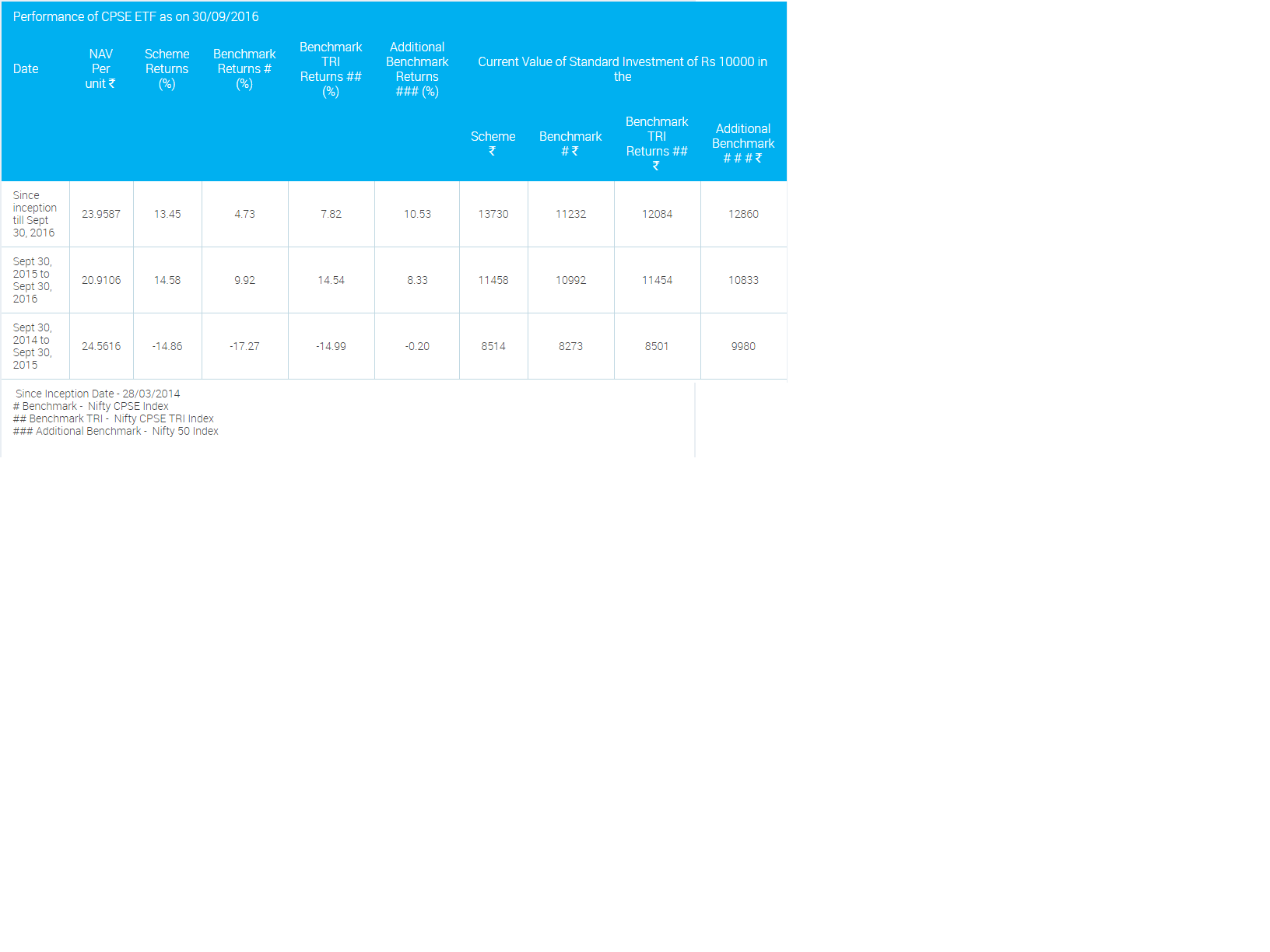
From 2017 to 2021, the fund delivered poor returns. PSU companies were out of favour. Government interference in business decisions, underinvestment, and competition from private sector players kept valuations suppressed. Investors who bought in 2017 on the back of “discount + loyalty units” and held through this period were frustrated.
From 2021 to 2024, the picture reversed dramatically. The government’s push on infrastructure, energy transition, and capital expenditure drove a sharp PSU re-rating. The Nifty CPSE Index surged. As of early 2025, the 5-year return was approximately 42% CAGR – among the strongest thematic ETF performances in that period.
Both eras are real. Both were unpredictable. And that is precisely the point about thematic investing.
The Thematic Investor’s Trap
In 25 years of advising, I have watched investors make the same mistake with every thematic fund: they buy after a period of strong performance, when the fund is on the cover of financial magazines and agents are pitching it actively. They buy at high valuations, after the easy money has been made. Then they hold through a long underperformance cycle and sell in frustration – just before the next recovery. This pattern has repeated with IT funds, pharma funds, infrastructure funds, and now PSU funds.
The best time to invest in a thematic fund is when nobody is talking about it. That is also, unfortunately, the hardest time to do so emotionally.
The Real Risks Worth Understanding
The CPSE ETF carries risks that a diversified equity fund does not. Understanding them matters before you commit any allocation.
Government policy dependency is the biggest one. The companies in the CPSE index do not make purely commercial decisions. Fuel price deregulation, disinvestment plans, environmental regulations, and infrastructure spending decisions are all made in New Delhi – not in boardrooms. A change in government priorities can materially affect returns across the entire fund in a way that has nothing to do with business fundamentals.
Sectoral concentration is the second issue. As of 2025, the fund has dominant exposure to energy, power, and oil and gas. If crude oil prices fall sharply, if renewable energy disruption accelerates faster than expected, or if government capex spending slows – the entire fund is exposed simultaneously. A diversified fund would be insulated by its other holdings.
Liquidity on the exchange matters for ETF investors. Bid-ask spreads on CPSE ETF can widen during volatile market periods. If you need to exit quickly in a falling market, the price at which you actually sell may be worse than the NAV you expect.
What Changed: RGESS and the Discount Model
Two features of the original CPSE ETF structure have been discontinued. The Rajiv Gandhi Equity Savings Scheme (RGESS), which previously allowed first-time investors a Section 80CCG tax deduction for investing in CPSE ETF, was abolished with effect from FY 2017-18. No new RGESS deductions are available.
The discount model – where new tranches were offered at 3-5% below market price, with loyalty units for long-term holders – was a feature of government-led FFOs (Further Fund Offers). Recent tranches have not followed this structure. Do not invest expecting a guaranteed discount. Evaluate the fund on its merits as a thematic equity investment.
Should You Invest? The Honest Assessment
If you have no equity exposure to PSU or infrastructure-linked companies in your existing portfolio, CPSE ETF can add a small diversification benefit. These companies tend to move somewhat differently from private sector-heavy indices, particularly during periods of government capex cycles.
But that is a minor portfolio optimisation argument. It is not a compelling standalone investment thesis for most investors.
The fund is appropriate for: investors who have a genuine view on the India infrastructure and energy investment cycle; those comfortable holding through multi-year underperformance when PSU stocks are out of favour; and those who want diversified PSU exposure without picking individual stocks.
It is not appropriate for: conservative investors who cannot stomach sector-level volatility; anyone treating it as a core equity holding; retirees or near-retirees who cannot afford a 3-5 year wait if the PSU cycle turns unfavourable.
If you do invest, keep it to 5% of your equity allocation at most. And review whether the PSU cycle is at an early or late stage before adding more.
A thematic fund should never be your only equity holding.
A diversified equity allocation – across market caps, sectors, and styles – is what actually builds long-term retirement wealth.
The core principle has not changed since 2017: thematic ETFs reward investors who buy early and hold patiently through cycles. They punish investors who chase recent performance and sell on frustration.
Whether CPSE ETF belongs in your portfolio depends entirely on where you are in your financial journey – not on its recent returns.
Past performance tells you where the train has been. It does not tell you where it is going next.
Invest in themes you understand. Size them as if you might be wrong.
Building a retirement portfolio means making decisions you can hold through cycles – not just through rallies.
That is what we build at RetireWise.
Your Turn
Have you invested in CPSE ETF or any other PSU-focused fund? What was your experience across the down cycle of 2017-2021 and the recovery since? Share in the comments.
There were no loyalty units this time.