
Last Updated on April 4, 2026 by teamtfl
Khushwant Singh died on March 20, 2014, at the age of 99. He was India’s most irreverent writer — columnist, novelist, historian, and proud whisky drinker. He left behind this verse that he loved to recite:
The horse and the mule live for 30 years, and know nothing of wines and beer.
The goat and sheep at 20 die, and never get a taste of Scotch and rye.
The cow drinks water by the tonne, and at 18 is mostly done.
The cat in milk and water soaks, and then in 12 short years it croaks.
The modest, sober, bone-dry hen, lays eggs for others, then dies at 10.
All animals are strictly dry; they sinless live and swiftly die.
But sinful, ginful, rum-soaked men survive for three score years and ten.
And some of them, though very few, stay pickled till they’re 92.
When I first read these lines two years before his death, I dismissed him. He was the son of Shobha Singh Ji — a man who owned half of Delhi — so what did he know of real hardship? His love for single malt and golden fried prawns was famous. Easy to be philosophical, I thought, when life has been generous.
Then he died. And the obituaries came. And in one of them, someone shared an article he had written at the age of 96 on how to stay happy. Eight simple points. Written by a man who had watched an entire century unfold — Partition, Independence, Emergency, liberalisation, the rise of a new India — and had lived through all of it with his eyes wide open.
I read those eight points and changed my mind about him completely. These are not the thoughts of a pampered man. These are the distilled observations of someone who had seen enough of life to know what actually matters. I share them here with my own commentary — because every single one of his points has a direct financial dimension that most people miss.
⚡ The Eight Points
Good health. A healthy bank balance. Your own home. An understanding companion. No envy. No gossip. A meaningful hobby. Daily introspection. Khushwant Singh wrote these at 96. They hold up completely in 2026 — and every single one has a financial angle that most people overlook.
How to Stay Happy — Khushwant Singh’s Eight Points, with My Notes
“I’ve often thought about what it is that makes people happy — what one has to do in order to achieve happiness.”
First: Good Health
“First and foremost is good health. If you do not enjoy good health, you can never be happy. Any ailment, however trivial, will deduct something from your happiness.”
(Health is now the most precious and expensive asset a person can hold. I see youngsters dealing with hypertension, diabetes, insulin resistance — all by their early 40s. The process of earning a comfortable life takes a systematic toll on health. Be in a career or business that does minimal damage to your body. Build investment practices that keep you calm, not anxious. A retirement corpus built on a broken body is a poor trade.)
Second: A Healthy Bank Balance
“It need not run into crores, but it should be enough to provide for comforts, and there should be something to spare for recreation — eating out, going to the movies, travel and holidays in the hills or by the sea. Shortage of money can be demoralising. Living on credit or borrowing is demeaning and lowers one in one’s own eyes.”
(Notice he did not say “maximize your net worth.” He said enough — with some to spare. The answer to “how much is enough?” is goal formulation. Know what amount you need for which goal. Arrive at a savings rate that gets you there. Debt is a burden that quietly chips away at your self-respect. Even if you repay your credit card every month, ask yourself: why are you resorting to short-term credit for monthly consumption in the first place?)
Third: Your Own Home
“Rented places can never give you the comfort or security of a home that is yours for keeps. If it has garden space, all the better. Plant your own trees and flowers, see them grow and blossom, and cultivate a sense of kinship with them.”
(I agree — property is part of a complete asset allocation. Emotionally, there is no question that a home of your own provides a sense of permanence and dignity that renting cannot replicate. The financial question is not whether to own, but when, where, and at what price. Those are the calculations that matter — and the ones most people skip because the emotional pull is so strong.)
Fourth: An Understanding Companion
“If you have too many misunderstandings, it robs you of your peace of mind. It is better to be divorced than to be quarrelling all the time.”
(An understanding partner is the most underrated variable in a financial plan. Your spouse should be involved in every significant financial decision — not just informed after the fact. And Khushwant Singh is right that a bad marriage is expensive in every sense. Divorces are financially and emotionally draining. Choose your life partner with as much care as you give your largest investment.)
Planning a life — not just a portfolio?
At RetireWise, we help senior executives build retirement plans that account for life as it actually is — health costs, family obligations, the home question, and what “enough” really means for you.
Fifth: Stop Envying Others
“Stop envying those who have done better than you in life — risen higher, made more money, or earned more fame. Envy can be corroding; avoid comparing yourself with others.”
(Stick to your own goals. Someone else has a different life, a different starting point, and different priorities. Do not get pulled into buying a bigger car, taking a more expensive holiday, or making an aggressive stock bet because a peer did it. Their financial plan is not your financial plan. The day you stop comparing is the day your financial decisions get dramatically cleaner.)
Sixth: Avoid Gossip
“Do not allow people to descend on you for gup-shup. By the time you get rid of them, you will feel exhausted and poisoned by their gossip-mongering.”
(In financial life, gup-shup is herd mentality. The WhatsApp group tip, the neighbour’s hot stock, the relative’s guaranteed scheme — all gossip in financial clothing. Advice is always free to give and cheap to take. But advice worth acting on carries a price — the price of qualified, accountable, fee-based counsel from someone who has skin in getting it right.)
Seventh: Cultivate a Meaningful Hobby
“Cultivate a hobby or two that will fulfil you — gardening, reading, writing, painting, playing or listening to music. Going to clubs or parties to get free drinks, or to meet celebrities, is a criminal waste of time. It’s important to concentrate on something that keeps you occupied meaningfully.”
(Every rupee spent on a meaningful hobby is money well spent. Every rupee spent on impressing others is money that evaporates. Beyond the financial dimension — a meaningful hobby is your retirement plan’s greatest ally. Retirement without purpose is retirement without happiness. The people I see most at peace in their 60s are the ones who had a second life waiting for them beyond the office.)
Eighth: Daily Introspection
“Every morning and evening devote 15 minutes to introspection. In the mornings, keep the mind absolutely quiet.”
(Every serious thinker on happiness — from the Stoics to modern psychology — arrives at this same point. Elizabeth Gilbert captured it well in Eat, Pray, Love: “We search for happiness everywhere, but we are like Tolstoy’s fabled beggar who spent his life sitting on a pot of gold, under him the whole time. Your treasure — your perfection — is within you already. But to claim it, you must leave the busy commotion of the mind and abandon the desires of the ego and enter into the silence of the heart.” The financial version of this is simple: a quiet mind makes far better long-term decisions than a reactive one.)
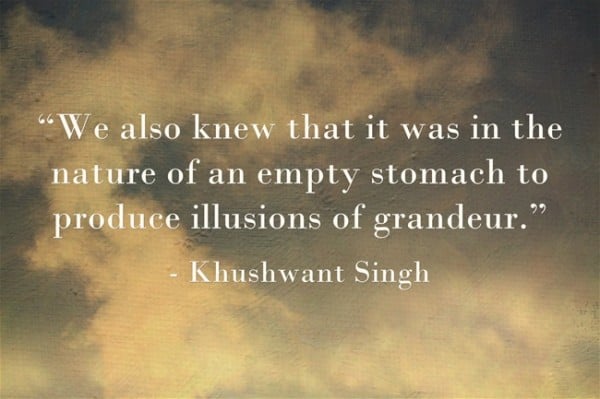
A man who lived to 99 and wrote these eight points at 96 understood something most financial plans miss entirely: money is a means, not a destination. Khushwant Singh never confused the two.
Plan your finances so you can live his eight points — not so you can afford to ignore them.
💬 Your Turn
Which of Khushwant Singh’s eight points do you find hardest to actually live — not just agree with? Share below.
The ditty the article begins with – was it composed by Khushwant Singh or someone else?
thanks for sharing. so simple and sweet.
Absolute Gems of wisdom. Great article sir.
Very….amazing
i have never seen such a tremendus tuth of life in a so practicl way……khuswant singh lived his life in his own way without any chaos and nagging.
Wow..amazing..
I never read any book by Khuswant Singh for I didn’t like his views on life, women. But then after his death read about him and realised that he made Santa Banta jokes popular and also have done some good research work ex History of Sikhs.
This is a very interesting article and helps us to prioritise. As they sayWise men learn by other men’s mistakes, fools by their own.
Hi Hemant
Today somebody sent me the article which had two more points. One is about anger and the other is about death. I think the control over anger though very difficult is also very important as anger can spoil many relationships. One can become very humble if one understands the reality of death. I think it is very important for our politicians to understand these points as one can see the type of arrogance they exhibit and the type of language they use. This is really very disgusting.
good article
wish u could also share on similar books
read ur piece after going through a friends e mail on similar subject sans the financial part
Hi Hemant,
Thanks for the article. I will start following some points in the article like introspection, hobbies etc.,
I have written an article on mutual funds & its advantages. Would you like to publish it in your blog please?
Hi Hemant — good reading of Khuswant who had a very emotional and facinating life style. I always read his comments — read few books and met him personally once. A charming person and reading his 8 commandments in your article was indeed inspiring. The missing 2 of his life are more fun and fun….
Hi Hemant,
As usual, a great post.. I am wondering, how you only come across nice nice articles and not me 🙂
Really wonderful. I agree hobby is one of the valuable point. Especially, when people working in IT companies and in shifts, they tend to think nothing but work profile. But when they retire, they do not know what to do further.
Especially, when women take a break for parenting and other such reasons, for them, hobby is very important to keep their mind active :).
Spending quality time with kids is also one of it , it gives immediate happy feeling, keeps positive boost in your life, also in long run helps to achieve a healthy relationship between parent and kids, and build them into a strong personalities for society..
Hi Hemant
I have been reading columns of Khushwant Singh in newspapers and magazines for many years and found them very interesting.All the points mentioned are very good. Health is no doubt most important. Hobbies like gardening are very good especially for retired people. Unfortunately you can not enjoy gardening if you live in an apartment.
‘How to stay happy in life’ 🙂 when will people tire of pursuing happiness in the wrong place i.e. the vast world outside! It lies elsewhere baba…it lies somewhere within you – really, truly, absolutely true – personal experience se bol rahi hoon dears… if you don’t get this now you will when zindagi se do maar khayenge tab. As far as Khushwant Singhji’s tips, with all due respect to his age, which is 3 times mine, if only he really introspected on his reality within, he would have given much deeper tips on the same….my 2 pence. You can ignore if it isn’t to your taste. But someday you will know what I mean I am sure – no one escapes it at some time or other anyways. Want to be happy? Look for it in the right place & not everywhere that it’s never meant to be, anyway
Free reading on ebook,is it practicable,?Khushwant shing’s which books r available on ebook?
Comments are closed.