
Last Updated on April 22, 2026 by Hemant Beniwal
“Champions keep playing until they get it right.” – Billie Jean King
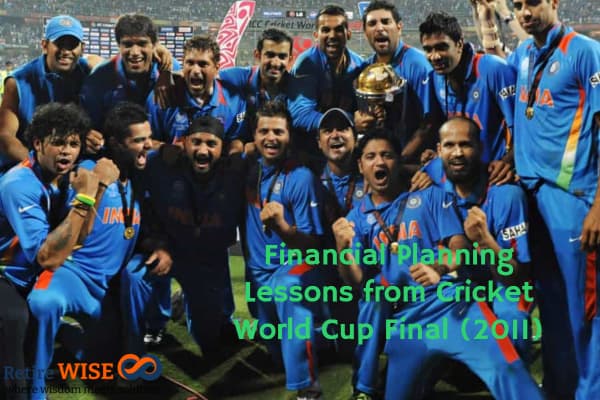
I wrote the first version of this post on the night of April 2, 2011. India had just beaten Sri Lanka in the World Cup final. Dhoni had promoted himself up the order. Kohli had carried Sachin on his shoulders. The country was awake till 2 AM.
Thirteen years later, in Barbados on June 29, 2024, Rohit Sharma lifted the T20 World Cup. Virat Kohli played one of his most important innings of the decade under pressure. Hardik Pandya, carrying the weight of IPL criticism and public judgment, bowled the final over and held his nerve when South Africa needed 16 off 5 balls.
Two different formats. Two different generations. The same financial planning lessons.
⚡ Quick Answer
Cricket and financial planning share seven core principles: set a target (financial goal), diversify your portfolio (like a balanced batting lineup), don’t judge on short-term performance (Zaheer’s bad overs don’t make him a bad bowler), beware of mis-selling, find the right coach (financial planner), keep your eyes on the goal not the scoreboard (market levels), and take responsibility for your own financial captaincy. These lessons hold across every World Cup and every market cycle.
Lesson 1: Set a Target and Plan Extra for What You Haven’t Planned
After the 2011 final, Sangakkara said: “If you need to beat India, you have to score 350.” He was planning for the goal he needed, with a buffer for the unexpected.
In retirement planning, the equivalent is not planning for what you expect to spend, but planning for what life might actually cost. Healthcare inflation runs at 8-10% annually. Your parents may need care. Your retirement may last 30 years, not 20. The investors who retire comfortably are those who built in a buffer – typically 20-25% above their estimated corpus need – rather than those who planned exactly to the number.
A retirement plan that assumes everything goes right is not a plan. It is a wish.
Lesson 2: Asset Allocation Is a Batting Lineup, Not a Single Star
In the 2011 final, Sreesanth bowled poorly. It did not matter because Zaheer, Yuvraj, and Harbhajan collectively built enough pressure. In the 2024 T20 final, Bumrah’s figures were outstanding but it was the collective effort across all departments that won the game.
A portfolio that depends on one asset class – entirely equity, entirely FDs, entirely real estate – is a team built around a single player. When that player has a bad day, the whole team suffers. Diversification across equity, debt, gold, and real assets means that when one asset class underperforms, the others carry the weight. No single instrument needs to be perfect every year. The portfolio needs to be resilient across years.
Lesson 3: Don’t Judge Investments on Short-Term Performance
In the 2011 semi-final against Pakistan, Sehwag got out for a duck and Zaheer gave away runs in the death overs. If you judged them purely on that match, you would drop them both. But in the context of their careers and the tournament, they were still two of India’s most valuable players.
A mutual fund that underperforms the Nifty for one year, or even two years, is not automatically a bad fund. A quality fund manager going through a style cycle is not permanently broken. The investors who exit good funds during underperformance and enter recently outperforming funds are doing the equivalent of dropping Zaheer after a bad spell and picking someone with great recent figures – who then gets hit for 20 in the crucial final.
Give your investments a time horizon appropriate to the asset class. Equity deserves at least 5 years. Judge it over cycles, not quarters.
Lesson 4: Beware of the Toss – and of Mis-selling
There is an old story about the 2011 final toss – whether the right coin was called, whether something irregular happened. The details were disputed. The lesson was clear: even before you start investing, the process can be manipulated by those who benefit from your confusion.
The financial services equivalent is mis-selling: a product presented as safe that isn’t, returns quoted without mentioning the exit load or tax, insurance packaged as investment, or projected returns that assume the best-case scenario continuously. The way to protect against it is the same as in cricket: understand the rules before you play, verify the claims, and do not hand over your financial life to someone who benefits more from your decision than you do.
Lesson 5: Find a Gary Kirsten
Gary Kirsten barely smiled during the entire 2011 World Cup campaign. He was not the star of any match. Nobody interviewed him at the end of a victory. But every player – Sachin, Dhoni, Kohli – credited him as the foundational reason for India’s success. He saw what the players couldn’t see about themselves. He asked better questions than he gave answers. He created the environment where the talent could perform.
A good financial planner is Gary Kirsten. Not the person making the headlines by predicting the next stock market move. The one who quietly reviews your asset allocation before it becomes a problem, who holds you to your plan when you want to exit during a crash, who reminds you of your 2011 goals when you are distracted by 2025 market noise.
In March 2020, one of my clients called me at 8 PM. The markets had fallen 35%. He wanted to redeem everything. I reminded him of the stress test we had run when we built his plan – the one that showed his portfolio could withstand a 40% fall and still fund his retirement at the original timeline. He did not redeem. By December 2020, his portfolio had fully recovered.
That call, not any stock selection, was the value of having a financial planner.
Lesson 6: Eyes on the Goal, Not the Scoreboard
In the 2011 final, the Indian chase was shaky at the start. In the 2024 T20 final, South Africa came desperately close in the last over. In both cases, the players who performed under pressure were the ones who focused on the process – the next ball, the next delivery – rather than on the required run rate or the overall match situation.
Your equivalent of checking the scoreboard too often is checking your portfolio value daily. Or weekly. Or even monthly, if you are a long-term investor. Every time you see a portfolio value below where you bought, the brain registers a loss. Research consistently shows that the more frequently an investor reviews their portfolio, the more anxious they become, and the more likely they are to make a poor timing decision.
Set your portfolio review schedule to once per quarter for SIP investors and once per year for long-term goal tracking. Look at the goal progress, not the daily NAV.
Lesson 7: Take Responsibility – You Are the Captain of Your Financial Family
In the 2011 final, Dhoni promoted himself above the in-form Yuvraj, took the pressure of a match-deciding innings at the biggest possible moment, and delivered a six to finish the game. Nobody asked him to. He decided. He backed himself. And when it worked, the credit belonged to every member of the team.
You are the Dhoni of your family’s financial plan. No one else will decide when to start your child’s education SIP, when to buy adequate health insurance, when to review your asset allocation. The financial system is designed to make decisions for you – by selling you products, by defaulting your savings to savings accounts, by letting your insurance lapse. Inaction is a decision. Delegation without oversight is a decision. Taking responsibility means owning the process, even when it is uncomfortable.
The financial decisions that protect your family – adequate term insurance, a written will, a structured retirement corpus – are as hard to commit to as Dhoni promoting himself up the order. But they are the decisions that matter most.
The March 2020 Lesson
During the COVID crash of March 2020, one of my clients called wanting to exit her daughter’s education corpus entirely. She asked me: “Is this corpus safe enough for her admission in 2023?” We looked at the stress test together. The corpus, even after the crash, was adequate for the goal at the target date. She stayed invested. By June 2020 it had largely recovered. The goal was not affected. The panic had no basis in the actual plan – only in the day’s newspaper.
A retirement plan with a written stress test is the equivalent of a match plan. It gives you something to return to when the scoreboard looks frightening.
Cricket and financial planning share one truth: process beats panic, every time.
RetireWise builds financial plans with stress tests, clear goals, and the discipline to stay on course when markets look like the last over in Barbados.
India has won the World Cup with different captains, different formats, and different playing conditions. The principles that produced those victories have not changed. Neither have the principles that produce retirement security.
Do the right thing. Sit tight. Back your plan.
Every investor needs a Gary Kirsten. A good financial planner is that person.
RetireWise works with senior executives across India on their retirement plans – the ones that hold when markets look like the last over in Barbados.
Your Turn
Which of the seven lessons resonates most with where you are in your financial planning right now? And is there a cricket parallel from any World Cup that taught you something about your money? Share in the comments.
i want to purchase a health policy for me. but all the healthcompanys giving different different quotes who is correct i can not understand. so i am so much confusing. when the claims comes who will pay correct amount. pl. help me in this matter thanking you.
Dear Sreedevi,
Every company has its own policy and product so it is natural that their premium amount and quotes will be different. No company can deny to pay claim amount if you have provided them correct information while taking policy.
“Do not fight with a pig as it is the pig that enjoys a mud fight, but you get dirty in the bargain”…..very well said…..very good article……keep going…its makes us rich in financial knowlege.
Hi brij bhushan pandey.
Why only World Cup, we can learn also from test cricket currently being played by India.Wealth creation is like Test Cricket where a quick fifty or hundred may not always win you a game.You need the solidity of Rahul Dravid and Laxman more often than the flamboyance of a Virat Kohli to be able to emerge victorious over the five days.
Reply
Great great artical……. Just loved it…… Super liked…..
i hav ready many many articles… Usually i dont comment on any….. But for this article i cant stop myself
🙂
Hi Hemant
Why only World Cup, we can learn also from test cricket currently being played by India.Wealth creation is like Test Cricket where a quick fifty or hundred may not always win you a game.You need the solidity of Rahul Dravid and Laxman more often than the flamboyance of a Virat Kohli to be able to emerge victorious over the five days.
Hemant,
Learn a lot from you. Now again to invest in mutual fund should we go through broker or we go indipendently by own choice. which is the best option , PLz suggest
Regards,
Munish
O! What an article! I bow to you, Hemant Ji, for writing such an excellent article. I would give this article a title “The need for financial planning – in a NUT SHELL”!
Thanks Jayashree 🙂 🙂
Must share this article with ur friends.
Hemant Bhai,
The best line that Cricketer commentators use is: Cricket is the game of UNCERTAINITY. If I translate in the Siddhu’s language it goes like this:
Kabhi Lamha hai , Kabhi Khwab to Kabhi Manjar hai Jindagi,
Jo Na Samjhe to Khanjar or Nibh jaye to Sikandar hai Jindagi
Hope we all make our financial life SIKANDAR. 🙂
Hi Madhupam,
Aap to shayar bhi nikle.
But I am bit worried that why there is only 1 comment on this article. May be I was bit late in writing this 🙁