

Last Updated on April 5, 2026 by teamtfl
In 25 years of managing money for senior executives, I have noticed something. The clients who build real wealth are not the smartest ones. They are not the ones who found the best stock or timed the market perfectly.
They are the ones who followed a few simple principles — and never stopped following them. Even when it was boring. Especially when it was boring.
Here are the 12 investment mantras I have seen work, over and over, through bull markets, crashes, scams, and everything in between.
⚡ Quick Answer
The 12 mantras that matter most: have a strategy before you invest, ignore get-rich-quick schemes, stay humble, choose fee-only advisors, be patient, invest slow and systematic, stop chasing past returns, control your emotions, educate yourself, avoid over-optimism, put your savings to work, and accept mistakes quickly. These are not new ideas — but the gap between knowing them and actually following them is where most investors lose money.
1. Have a Strategy Before You Invest a Single Rupee
A 45-year-old CTO from Bangalore — Vikram (name changed) — came to me with Rs 2.3 crore scattered across 47 mutual funds, 3 ULIPs, 2 endowment plans, and 11 direct stocks. He had been investing for 18 years. His portfolio had no strategy. No asset allocation. No goal mapping. Just random purchases triggered by tips, news, and banker calls.
We consolidated it into 6 funds aligned to his goals. His returns improved not because we found better funds, but because the portfolio finally had a purpose.
Markets will always be unpredictable. Your strategy should not be.
2. If It Sounds Too Good, It Is
Every few years, India gets a new get-rich-quick scheme. Speak Asia in 2011. Bitcoin mania in 2017. F&O trading hype on social media in 2023-24. SEBI’s own study found that 93% of individual F&O traders lost money over a 3-year period. The average loss was Rs 2 lakh per person.
The people who made money from these schemes were the ones selling them — not the ones buying in.
A disciplined SIP in a simple Nifty 50 index fund has delivered roughly 12-14% CAGR over most 10-year periods. That is not exciting. It is just wealth.
3. Stay Humble — The Market Is Smarter Than You
The moment you start thinking you have figured out the market, it will humble you. I have seen it happen to PhDs, IIT graduates, and people running billion-dollar businesses. Intelligence does not protect you from overconfidence.
Humility in investing means accepting that you do not know what the market will do next month. It means diversifying instead of concentrating. It means listening when someone challenges your thesis.
4. Choose Your Advisor Like You Choose Your Doctor
Would you trust a doctor who earns more money when you are sicker? That is exactly how commission-based financial advice works. The advisor earns more when they sell you products — whether or not those products are right for you.
A fee-only advisor — one who charges a flat fee or a percentage of assets and earns zero commission — has no incentive to push products. Their only incentive is to keep you as a long-term client by giving you good advice.
SEBI-registered investment advisors (RIAs) are legally required to act in your interest. Commission-based distributors are not.
5. Patience Is Not a Virtue — It Is the Strategy
Rahul (name changed), a senior VP at a pharma company, invested Rs 50 lakh in equity mutual funds in January 2020. By March 2020, his portfolio was down 35%. He called me in panic.
I told him one thing: “Do nothing.”
By December 2021, his portfolio was up 80% from the original investment. The Rs 50 lakh had become Rs 90 lakh. Not because we made any brilliant move. Because we did not make a stupid one.
Patience in a falling market is the single most valuable skill an investor can have. It costs nothing and earns everything.
6. Slow Money Beats Fast Money
The wealthiest clients I have worked with did not make their investment money quickly. They made it systematically — monthly SIPs, annual step-ups, reinvested dividends — over 15-20 years. The compounding did the heavy lifting.
Speed investing — jumping in and out based on market noise — is how traders lose money and brokers make it.
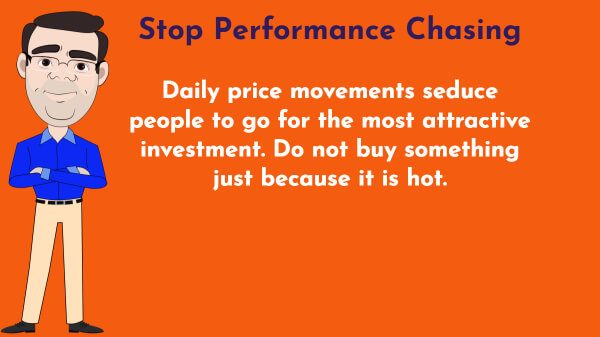
7. Last Year’s Winner Is Often Next Year’s Loser
If chasing returns worked, every investor would be rich. They are not — because the fund that returned 40% last year is often the one that returns 5% the next.
I have seen this cycle repeat in every market condition. Small cap funds in 2017. Sectoral funds in 2020. PSU themes in 2023. By the time retail investors pile in, the easy money has already been made.
Stick with your diversified funds. Let the performance chasers chase.
8. Your Emotions Are the Most Expensive Thing in Your Portfolio
Fear makes you sell at the bottom. Greed makes you buy at the top. Regret makes you chase yesterday’s winners. Overconfidence makes you concentrate in one stock.
Every expensive mistake I have seen in 25 years of advising had an emotion behind it — not a calculation.
The best investors I know are not emotionless. They just have a system that prevents their emotions from becoming transactions.
9. What You Do Not Know Will Hurt Your Portfolio
A client once held Rs 15 lakh in a ULIP for 8 years without knowing the charges were eating 3% of his corpus every year. He thought he was invested in a “good plan” because his banker told him so.
Ignorance is not bliss in investing. It is a tax — paid silently, annually, and irreversibly.
Read the fine print. Understand the expense ratio. Know what you own and why you own it.
10. Optimism Is Good — Blind Optimism Is Expensive
“This time it is different” is the most expensive sentence in investing. Markets recover — but individual stocks sometimes do not. Sectors rotate. Companies go bankrupt.
Rational optimism means believing in long-term growth while accepting that your specific portfolio could be wrong. It means reviewing, rebalancing, and sometimes admitting that an investment has failed.
11. Savings Sitting in Your Bank Account Are Losing Value Every Day
At 3.5% interest in a savings account and 5-6% inflation, your money loses purchasing power every single day it sits in the bank.
Rs 1 crore in a savings account today will buy you only Rs 55-60 lakh worth of goods in 10 years. That is not safe. That is the slowest way to go broke.
Move your surplus into a combination of equity, debt, and gold — based on your goals and timeline. Even a simple mutual fund SIP is dramatically better than a savings account.
12. Admit Your Mistakes Fast — Cut Your Losses Faster
What do you do when you take a wrong turn while driving? You turn around. You do not keep driving in the wrong direction hoping the GPS recalculates.
The same logic applies to investing. If a stock has fundamentally deteriorated, sell it. If a fund has consistently underperformed its benchmark for 3+ years, replace it. If a ULIP or endowment policy was mis-sold to you, exit it.
The cost of admitting a mistake is small. The cost of holding on to a mistake is compounding — and not in your favour.
Following the mantras but still not sure about your portfolio?
A fee-only advisor can review your investments and align them with your actual life goals — not someone else’s tips.
These 12 mantras are not about money. They are about discipline, patience, and the quiet courage to do nothing when everyone around you is doing something stupid.
The real investment mantra? Build a plan you can sleep with — and then actually sleep.
💬 Your Turn
Which of these 12 mantras has been the hardest for you to follow? For me, it was #5 — patience during the 2020 crash tested everything I believed. What about you?
This article was originally contributed by Anil Kumar Kapila, a long-time reader. It has been substantially rewritten and updated with practitioner perspectives and 2026 data.
Hi Hemant,
I am 30, married since 5 years & with 2 year kid. My goals are buying house (2 years from now), daughter’s study & marriage, pension (needed 25 years from now) & a significant health corpus. I don’t have any loans/debts etc. Could you please comment on & suggest/modify my MF portfolio below ( started Dec, 2011 ) ? Any advice from your side would be highly appreciated.
Fund Category Monthly Allocation
ICICI Pru Focussed Bluechip Equity Fund Large Cap 3000
ICICI Pru Discovery Fund Midcap & Small cap 3000
IDFC Premier Equity – A (G) Midcap & Small cap 3000
SBI Magnum Emerging Busi (G) Midcap & Small cap 5000
UTI MNC Fund (G) Diversified Equity 2000
Reliance Gold Savings Fund (G) Gold 2000
SBI Magnum FMCG Fund (G) Sectoral-FMCG 3000
Hi Salil & Experts,
I am 30, IT Professional (only breadwinner in family), married since 5 years (& have a daughter of 2.5 years).
I have a LIC Moneyback Policy since last 6 years for which a pay a premium of INR 18000 annually & it pays me back INR 50000 every 4 years. Also, I started a ULIP Child Plan (ICICI Smart Kid) last year, where I pay INR 25000 annually for a SA of INR 5 lakhs.
These 2 policies, 1 Term Insurance Plan (from ICICI), 1 Mediclaim Plan (Oriental Family Floater) & 1 ELSS constitute my tax planning.
I am going to dis-continue the LIC Moneyback Policy, immediately & might re-consider dis-continuing the ULIP Child Plan as well. I believe, one should never fall in trap of low-yielding policies such as Moneyback, Pension, Endowment, ULIP etc. at least, at my current stage. I already have monthly SIP worth INR 21000 in 6 Equity mutual funds.
Could you please suggest where should I channel this INR 18000 annually (+ INR 25000, probably)? My goals are house (2 years from now), daughter’s study & marriage, pension(25 years from now) & a significant health corpus. I dont have any loans/debts etc.
Your suggestions regarding my portfolio & best possible avenues for investment of INR 18000 annually (or maybe, INR 43000), would be highly appreciated.
Regards,
Rahul
Hi Anil ,
sorry if I hurt your feelings–the idea was not to malign you in any way.
keep up the good work . And yes, I do agree that one keeps reading/hearing the same financial planning words repeatedly.
Thanks! Shreedhar
Hi Kirti
Just two won’t do. Even one investment mistake can prove fatal for your portfolio. In fact I have many more in mind.
You are right Sir, a single investment mistake can prove fatal to our portfolio. Looking forward to more such ideas.
I would rate your “Do not invest without a sensible investment strategy” as the most important one. If we have a plan in place and follow it then all things would fall in place: we will be able to remain humble, avoid get-rich-quick schemes, avoid deceitful financial advisors, not be impatient with our investments etc.
Having a plan is foremost as Failing to Plan is Planning to fail and then its execution with realization that things may go wrong and learn to accept a Loss /mistake and correction.
12 mantras goes in sync with 2012 but just remembering them seems a task(I tried telling about these mantras to my friend in the evening and ran out after 7). But was wondering – if I have to choose two, just two which one would you recommend? Doing all these things seems a lot and scares off most people
I whole heartedly second the comments by Mr. Kirti
Thanks! Pradip.
Good mantras not just for 2012 but for one entire financial life! A new year is a good place to revisit the basics. Thanks for sharing it!
Thanks! Kirti.
Nice , useful and interesting article.Pl keep on writing such types of articles.Also pl write about regarding Gold ETF/Gold Fund with its benefits and drawbacks.
Hi Kaushal
Thanks! Please refer to the old articles to get information regarding Gold ETFs and Gold funds.
Thank Anil ji and Hemant ji for giving us a direction to stick to,
All the best to you and all the readers may 2012 bring g8 wealth to everyone.
Keep writing whenever time permits, we will be waiting eagerly for your article.
regards
Thanks Tony Gomes. Best wishes to you for 2012.
Thank you for sharing such a nice article. This reminder was much needed!
Sunnydoc
Hi Hemant
I have found that in the investment world there are certain words and phrases which seem to be used by almost all authors daily. I have repeatedly come across – Asset Allocation, Rebalancing, Diversification, Portfolio Construction, Core and Satellite Approach, Not putting all eggs in one basket, Not throwing good money after bad money, Keeping things simple, Not mixing investment and insurance, Emotional investing etc, etc.I don’t think anybody has copyright of these words and phrases. It is quite natural that in investment related articles these words and phrases will be repeated again and again. I don’t understand why anybody should have any issue with use of words.
Moreover this is not a research paper where a bibliography needs to be given.
Great article ., though seems to be a repeat–infact items 7 to 11 are an exact repeat ,even the words of what I have been getting e-mails in the last wk of 2011. Hemant, s uggest we acknowledge the source when the matter is not our own. regds
Hi Shreedhar,
This article is a Guest Post by “Anil Kumar Kapila” – I think he should answer this.
Hi N.M.R.Shreedhar
As far as the fundamentals of investment are concerned they remain same and most of the people use practically the same language to describe them. I read many personal finance magazines and blogs and get influenced by many authors. I have also recently read several articles on new year resolutions and investment strategy to be adopted in the new year by many authors and find that most of them have said the same thing using practically the same language. I do not claim that what has been written is something original discovered/invented by me. I have just tried to share what I have learnt from different sources.
Hi Shreedhar,
I agree with Anil, this is a very generic article – if someone want to write an article of “Benefits on Mutual Funds” – it is obvious that points will be repeated. And I believe Anil has not copy pasted the lines.
Nice article Anil. It’s the most basic things that are repeated over and over again yet people fail to follow. Good job reminding.
Hemantji, please do some posts on value investing if time permits. It’s just that you make it simple to understand 🙂
Hi Mansoor,
Sure I will write something on Value……..
Thanks Hemant and Manshu for editing and providing beautiful graphics.
Thanks Anil for contributing such a nice article.