

Last Updated on April 5, 2026 by Hemant Beniwal
I was speaking at a corporate workshop in Pune last year. About 40 people in the room — mostly senior managers, early 50s, earning well.
I asked one question: “How many of you have a written post-retirement plan — not a vague idea, but an actual plan with numbers?”
Three hands went up. Three out of forty.
I wasn’t surprised. Because the number I’m about to share with you explains everything about why retirement in India is a slow-moving crisis that nobody wants to talk about.
The number is 77%.
Seventy-seven percent of Indians have no post-retirement plan. Not a bad plan. Not an incomplete plan. No plan at all.
This comes from an RBI survey on household finances. And while the survey itself is a few years old, every subsequent study has confirmed the same direction — the number hasn’t meaningfully improved. If anything, with the gig economy expanding and formal pension coverage shrinking, it may be worse today.
Let me unpack what 77% actually means — not as a statistic, but as a lived reality.
⚡ Quick Answer
77% of Indians have no post-retirement plan according to RBI data. Over 50% expect to depend on their children. India ranks dead last (48th of 48) in the 2024 Mercer Global Pension Index. The retirement savings gap is growing at 10% annually. The bitter truth: if you haven’t planned, you’re not an exception — you’re the majority. And the majority is in trouble.
What Does 77% Look Like In A Room?
Picture a family gathering. Ten uncles sitting around after dinner, talking about property prices and their children’s careers. Comfortable. Confident. Seven of them have no idea how they’ll fund the next 25 years of their lives after they stop earning.
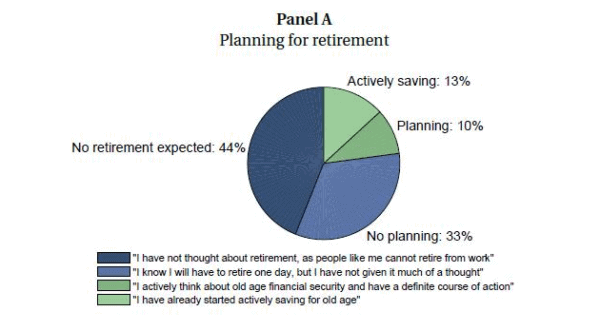
That’s the RBI finding: 44% of people haven’t thought about retirement planning because they feel they can never stop working. Another 33% know they’ll retire someday but haven’t thought about it or planned anything. Together, that’s your 77%.
And here’s where it gets darker. When the same survey asked people how they plan to fund their retirement, more than 50% said they’ll depend on their children. Another 25% said they didn’t know.
Let me say that again. Half the country’s retirement plan is: “Mere bachche dekh lenge.”
“Your children are not your retirement plan. They have their own EMIs, their own dreams, their own emergencies. Love them enough to not become their biggest financial burden.”
— Hemant Beniwal
Why 77% Isn’t Just A Planning Problem — It’s A Math Problem
Let me show you what happens when you don’t plan, using real 2026 numbers.
Take a 40-year-old earning ₹1.5 lakh per month today. Monthly household expenses: around ₹75,000. They plan to retire at 60.
At 7% inflation (the conservative number for India), their monthly expenses at retirement will be approximately ₹2.9 lakh. Not ₹75,000. Not ₹1 lakh. Nearly ₹3 lakh a month — just to maintain the same lifestyle.
If they live to 85 (which is entirely reasonable for a healthy urban Indian today — India’s life expectancy is already 70.82 and climbing), they need a retirement corpus of roughly ₹5-6 crore. That accounts for inflation continuing at 6-7% through retirement and a modest 8-9% return on a balanced portfolio.
Now ask yourself: does the average Indian professional have ₹5-6 crore saved for retirement? Most don’t even have ₹50 lakh.
This is what 77% looks like in rupees. It’s not that people don’t care. It’s that they haven’t done the math. And the math is unforgiving.
The Pension Myth That Makes It Worse
In many countries, a government pension provides a safety net. In India, that net has holes big enough to fall through.
Over 90% of India’s workforce is in the unorganized or gig sector — with zero pension coverage. No EPF. No gratuity. No employer contribution. Even for those in the organized sector, the Employee Pension Scheme (EPS) pays a maximum of ₹7,500 per month. Seven thousand five hundred rupees. That barely covers electricity and groceries in a metro city.
In the 2024 Mercer Global Pension Index, India ranked dead last — 48th out of 48 countries surveyed. Last. Behind countries with a fraction of our GDP.
This means one thing: you are your own pension fund. The government won’t save you. Your employer’s contribution alone won’t save you. Your children — who have their own homes to buy and their own children to educate — shouldn’t have to save you.
NPS is a step in the right direction, especially with additional tax benefits now available. But it’s one instrument. A post-retirement plan needs a full withdrawal strategy, not just an accumulation strategy.
77% have no plan. You’re reading this — which means you still have time to not be one of them.
Let’s build a retirement plan that survives inflation, medical costs, and 25+ years of life after your last salary.
The Three Silent Killers Inside That 77%
I’ve worked with hundreds of families over 18+ years. The ones who end up in the 77% don’t get there because they’re irresponsible. They get there because of three things:
First: debt that follows you into retirement. The RBI data shows that mortgage exposure actually increases as people approach retirement age. People take bigger home loans in their 40s, upgrade in their 50s, and carry EMIs into their 60s. A retirement with a running EMI isn’t really a retirement. It’s continued employment without the employment.
Second: gold and real estate obsession. Indian households convert savings into gold and property — almost reflexively. But gold doesn’t generate income. Property is illiquid. When you need ₹3 lakh a month in retirement, you can’t sell one room of your house every quarter. A diversified portfolio with proper retirement instruments generates monthly cash flow. A flat in Noida does not.
Third: medical inflation eating the corpus alive. Medical inflation in India has been running at roughly 10% per year — double the general inflation rate. A hospital stay that costs ₹5 lakh today will cost ₹13 lakh in 10 years. Your health insurance covers hospitalisation. It doesn’t cover the daily cost of being old — medicines, physiotherapy, domestic help, transport to doctors. That’s an out-of-pocket expense that grows every year.
What The Other 23% Do Differently
The 23% who have a plan aren’t geniuses. They’re not richer than you. They did three things:
They started early. Not at 55 — at 35 or 40. The difference between starting to invest ₹30,000/month at 35 versus 45 is the difference between ₹3.5 crore and ₹1.2 crore at retirement (assuming 12% equity returns). Same monthly investment. Same effort. Wildly different outcomes. Time is the only asset that money can’t buy back.
They got professional help. Not a bank relationship manager pushing the latest ULIP. A fee-only financial planner who built a retirement savings strategy — with inflation adjustments, worst-case scenarios, and a withdrawal plan for after retirement.
They reviewed annually. A retirement plan isn’t a document. It’s a living system. Tax rules change (senior citizens now get ₹1 lakh deduction on interest income under Section 80TTB — up from ₹50,000). Markets shift. Life happens. The 23% adjust. The 77% hope.
“The bitter truth about retirement planning is not that it’s complicated. It’s that it’s simple — and people still don’t do it. Because ‘later’ feels like a plan. It isn’t.”
— Hemant Beniwal
If You’re Reading This, You Have What The 77% Don’t
Awareness.
You know the number now. You can’t un-know it. The question isn’t whether retirement is coming — it’s whether you’ll meet it with a plan or a prayer.
Here’s what I’d tell you if you were sitting across from me right now:
Don’t calculate your retirement corpus based on today’s expenses. Project them forward at 7% inflation. The number will shock you — and that shock is the beginning of real planning.
Don’t count on post-retirement income. If it comes, great. Build your corpus assuming it won’t.
Don’t mix insurance with investment. Your insurance policies are probably not retirement instruments, no matter what the agent told you.
Don’t wait for a “better time” to start. There is no better time. There’s only less time.
And most importantly — make sure your nominee structures are in order. A corpus without clear succession planning creates a different kind of crisis for your family.
The 77% don’t have a plan. Today, you stop being one of them.
Whether you’re 35 or 55, a real post-retirement plan starts with one honest conversation about your numbers.
In that Pune workshop, the three people who raised their hands? They weren’t richer than the rest. They weren’t smarter. They’d just had one conversation with a planner, five years earlier, that the other thirty-seven kept postponing.
Seventy-seven percent is not a statistic. It’s a warning. And you still have time to heed it.
💬 Your Turn
Be honest — are you in the 77% or the 23%? And if you’re in the 77%, what’s the one thing that’s stopped you from making a post-retirement plan? Share in the comments — no judgment, just honesty.
Hemantji,
I’m sorry.I spent my entire earnings in children education & marriages.I also invested in lic for risk coverage to my wife after my death,( which has become paid up as I have undergone a serious accident & became unsalaried) I am 55 yrs old & need pension for lifetime of me & my spouse.I can get nine lacs if I surrender lic policies.Kindly suggest me how can I get immediate pension,with my invested & surrendered lic amount.
Nice blog. Thanks for sharing.
Interesting and surprising read. Can you please share the RBI report where the data has been sourced?
Hi Shailesh,
I got through a banker – I don’t have any link.
Thanks Hemant Ji for this inevitable quote which has deep meaning and truthfulness to live a heavenly life before going to heaven. “The retirement years are called the golden years. If you are prepared financially, you can enjoy this phase by spending time on things that you like and have a stress free life”
Thanks Partho – it’s important that we should try to bring balance between pre & post retirement life 🙂
Hi Hemant
I agree.Maintaining balance between pre & post retirement life is very important.
Hi Anil Ji,
Good to see you back?
Balance is really important.. specially if pre retirement lifestyle is extravagant.
Thanks Gopal 🙂
An eye opening article Hemant ji. Well said
If you have planned for your retirement, you are on the right track and if not, start planning now!