
Last Updated on April 22, 2026 by teamtfl
“The investor’s chief problem — and even his worst enemy — is likely to be himself.”
– Benjamin Graham
In March 2020, my phone did not stop ringing for five days straight. Markets had fallen 38% in less than a month. The Covid crash was brutal, fast, and completely disorienting. And in those five days, every investor type I have ever encountered in 25 years of practice called me — the Window Shopper, the Seasonal Trader, the Scapegoat, Hi-tech Lalaji, and Mr. Cool.
Same characters. Different decade. Same script.
This is the most important insight in all of behavioural finance: the market’s cycles change, but human psychology does not. The 2007-08 crash, the 2013 rupee crisis, the 2020 Covid collapse, the 2024 mid-cap froth — the indices are different, the triggers are different, but the five investor types respond in exactly the same way every single time.
Knowing which type you are is not an academic exercise. It is the difference between compounding wealth and destroying it.
⚡ Quick Answer
Markets move in cycles driven by emotion — Euphoria, Anxiety, Fear, Optimism. Five investor types respond differently in each phase: the Window Shopper (chronic pessimist), the Seasonal Trader (perpetual gambler), the Scapegoat (advice-follower who always arrives late), Hi-tech Lalaji (overconfident speculator), and Mr. Cool (patient long-term investor). The goal is not to avoid having emotions. It is to know your pattern well enough that you don’t act on it impulsively.
The Four Phases of Every Market Cycle
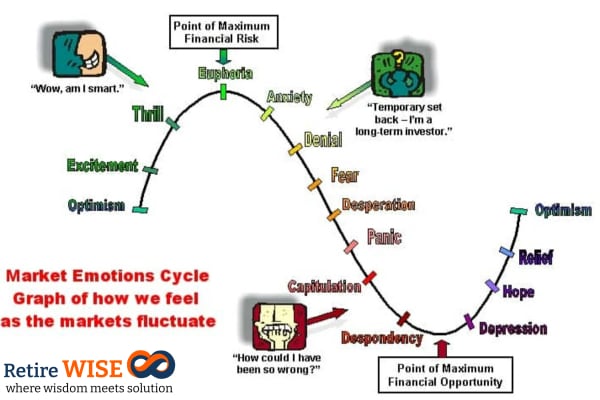
Before looking at the investor types, it helps to understand the emotional cycle that markets follow. This pattern has repeated across every bull and bear market in Indian history.
The Sensex cycle from September 2007 to September 2010 was a textbook example — a 40% rally in four months, followed by a 66% crash, followed by a slow grind back up. But the 2020 Covid crash and recovery was even more compressed and dramatic: a 38% fall in five weeks (February to March 2020), followed by a 100%+ rally in the next 18 months. Different numbers, identical emotional journey.
The four phases are: Thrill and Euphoria (market peaks, confidence is maximum), Anxiety and Denial (first signs of trouble), Fear and Panic (the crash deepens, hope evaporates), and Relief and Optimism (the slow grind back up).
Now let us watch what each investor type does in each phase.
Phase 1: Thrill and Euphoria
2007-08 example: Sensex jumped from 15,300 to 21,000 in four months. 2024 example: Mid and small cap indices doubled in 18 months, attracting record SIP inflows and NFO launches.
Window Shopper: “Market has gone up too much. It will crash to 6,000. I’m waiting.” He has been saying this from 2005. He will still be saying it in 2030. The goalpost always moves.
Seasonal Trader: Drops his diversified mutual fund SIP to chase the hottest sector theme — infrastructure, defence, PSU, whatever TV channels are promoting. Invests in an NFO because it is “new and cheap.” Adds leverage to “maximise the opportunity.” Already planning what he will do with the profits.
Scapegoat: His agent told him to invest. Returns were good. Agent is now recommending a new infrastructure theme fund. He invests in lump sum because “the market is rising.” Does not ask why. Trusts the agent completely.
Hi-tech Lalaji: Has made good paper returns. Decides this is the time to get leveraged — funding over existing mutual fund investments, IPO funding, derivatives. Gets tips from “inside sources.” Dismisses the pink papers and journalists as slow.
Mr. Cool: Checks valuations. PE ratios are stretched. Reads news carefully — “1,000 stocks in upper circuit for seven days. Fundamentals haven’t changed.” Sells the holdings that are significantly ahead of fair value. Waits.
Phase 2: Anxiety and Denial
2007-08: Sensex fell 30% in 10 days, from 21,000 to 15,300. 2024: Mid and small caps corrected 25-30% from peak in Q4 2024 after SEBI’s stress test concerns and FII outflows.
Window Shopper: “I told you. This is just the beginning. Wait for 3,000.” He feels vindicated. He will not buy at any level because there will always be a lower level predicted.
Seasonal Trader: “Broker auctioned my leveraged positions without informing me.” Borrows money from friends to average down. “Market has to recover. I’ll repay when I recover my losses.” This is now an emotional decision, not an investment decision.
Scapegoat: Agent says “correction phase is over, invest more to average losses.” Invests in lump sum again — the worst possible entry into a falling market. Agent is motivated to transact; client is motivated by hope.
Hi-tech Lalaji: Portfolio is down significantly but “Mumbai contacts say recovery is coming.” Adds more leverage to recover earlier losses faster. This is doubling down on a losing bet.
Mr. Cool: Still cautious. Valuations are falling but not yet compelling. Waits for more positive signals. Does not try to call the bottom. Does not act yet.
Phase 3: Fear and Panic
2007-08: Sensex hit 7,697 — a 66% fall from peak. Midcaps down 80-90%. 2020: Sensex fell from 42,000 to 25,638 in five weeks. COVID-19 declared a global pandemic.
This is the phase where wealth is permanently destroyed. Not by the market — by decisions made in fear.
Window Shopper: “This is why I don’t invest in equity.” Forgets that he never actually invested — so he has not lost anything, but he also has not compounded anything for the past decade. The sour grapes response.
Seasonal Trader: “I should have short sold!” Reacts to TV commentary in real time. Each new decision compounds the earlier mistake. No plan. Only reaction.
Scapegoat: “Papa was right. Equity is gambling.” Calls the agent — who has disappeared. Stops all SIPs. Switches to post office RD. Swears never to invest in markets again. Exactly at the point when long-term investors are entering.
Hi-tech Lalaji: Leveraged positions are being called. Desperate for capital protection schemes. Asks a PMS manager who “made 100% in the bear phase” to manage money. Does not verify the claim. This is the phase when the most spectacular frauds occur, because desperate investors are easy targets.
Mr. Cool: Buys. Good companies whose prices have fallen as much as bad companies, regardless of fundamentals. “This is the time for value buying.” His cash held back from the euphoria phase now deploys systematically.
What I Saw in March 2020
In the five weeks of the Covid crash, I had one client who wanted to redeem everything “before it goes to zero.” Another who wanted to deploy his entire emergency fund into markets “because this is the bottom.” Both were wrong, and both were operating on pure emotion. The first was a Scapegoat in crisis. The second was a Seasonal Trader with a new angle. Neither was Mr. Cool. Mr. Cool was the client who called me, asked if the stress test numbers we had done on his plan still held, confirmed they did, and said “let’s keep the SIPs going then.” That client is in a very different position today than the other two.
The retirement corpus stress test — running scenarios at 30-40% market falls — is not just an exercise. It is the document that gives you the confidence to stay invested when everything feels catastrophic. Without it, every crash becomes an emotional crisis rather than a financial event.
Phase 4: Relief and Optimism
2009: Congress election majority surprise. May 18, 2009 — markets hit upper circuit, trading suspended. 2021: Vaccine announcements. Markets crossed pre-Covid highs. Record SIP flows from new retail investors.
The recovery is slow at first, then sudden. Most investors who exited in Phase 3 miss the early recovery entirely.
Window Shopper: “I bought at the bottom.” He did not. He was waiting for 3,000 when it was at 25,000. But he convinces himself he “never cared about market direction.”
Seasonal Trader: “Markets taught me a lesson. I won’t repeat this mistake.” He will. “Which is the next IPO? What about gold? Which sector is hot?” Already moving to the next thing.
Scapegoat: His agent’s son is now selling ULIPs. “Highest NAV guaranteed plan — concept looks good.” He invests. The cycle is about to restart.
Hi-tech Lalaji: “Do you have products for HNIs? I heard there’s money in private equity, venture capital. Mutual funds are slow.” Has not learned the core lesson. Looking for complexity to replace the simplicity that would have served him well.
Mr. Cool: Nothing changed. Calm market day. Enjoying a family holiday. His portfolio has recovered and is at new highs. His returns are not from genius — they are from not making the mistakes others made in phases 1, 2, and 3.
Which Type Are You — Honestly?
Most people reading this will identify with Mr. Cool in theory and with one of the other four in practice. That gap between self-perception and actual behaviour is where wealth gets destroyed.
A few diagnostic questions worth sitting with:
When markets fell in 2020, did you reduce your SIPs or stop them? If yes, you are not Mr. Cool yet. When markets recovered, did you feel relieved and start more SIPs at higher valuations? That is Seasonal Trader behaviour. Do you make financial decisions based on agent recommendations without understanding the underlying instrument? That is the Scapegoat pattern. Do you feel certain about market direction based on information others do not have? That is Hi-tech Lalaji.
None of these types are stupid. They are human. The instincts that make us anxious during crashes and excited during rallies are the same instincts that kept our ancestors alive. They are just not well-suited to financial markets, where the counterintuitive action — buying when things feel terrible, not selling when things feel wonderful — is usually the right one.
The Retirement Implication
For investors approaching retirement, the stakes of getting this wrong are highest. A 55-year-old Seasonal Trader who exits equity in a panic at 60 and switches to FDs permanently may permanently impair the corpus he spent 30 years building. The sequence of returns in the five years around retirement is the most critical period in the entire investment journey.
The structural solution — not the psychological one — is to have a plan that is stress-tested before the crash happens. If you know your portfolio can sustain a 35% fall without requiring you to sell anything, the crash is less likely to trigger a panic response. You are not relying on willpower. You are relying on structure.
Willpower fails in a crash. Structure doesn’t.
A retirement plan stress-tested against market crashes is what separates Mr. Cool from everyone else during a crisis. That is what we build at RetireWise.
A mentally relaxed investor generally holds long-term positions, waits patiently for opportunities, and does not make investment decisions in a hurry. The overconfident investor makes decisions in seconds, assumes access to exclusive information, changes his mind moments later, incurs a loss, and feels confident he will recover it immediately.
The market rewards the first type. It taxes the second repeatedly.
The next market crash is not a question of if. It is a question of when — and who you will be when it arrives.
Keep your head cool. Think wise. Know which type you are before the crash tells you.
Retirement planning is not just about building a corpus. It is about building an investor who can hold it through a crash.
We help senior executives do both.
Your Turn
Which of these five investor types do you recognise in yourself — not in theory, but in how you actually behaved in March 2020 or during the mid-cap correction of late 2024? Be honest in the comments. The diagnosis is the first step.
Hi Hemant,
excellent article. MF route seems to be the safest way to investing though returns are not as much as stocks. how about investing in a few stocks for the long term if the fundamentals and the management is really good? after the Satyam scam, now it is HLL and Infosys going down ( last 3 qtrs have been bad), so stocks are raelly dicey, I guess. your views pls. regds.
Hi Shreedhar
Higher returns are linked with higher risk.Ultimately every thing depends on your risk appetite.
Hi Hemant
Direct investment in equity market is not my cup of tea.I prefer to invest in mutual funds via SIP route.Whenever market tanks I make small lump sum investments in mutual funds.
Wonderful & Insightful Article! I am in the process of learning & transitioning from ScapeGoat to MrCool. Thanks for the fantastic coverage across cycles/emotions. I have to bookmark this page to visit ever so often.
Hi Newbie,
In this case you must share this article with all your friends 🙂
You can also download full guide from top of this page.
I am quite sure a lot of retail investors would eneter markets at 21000 levels when media would be pouring news with Sensex target of 25000 in near term
Hi Mayank,
This happens every time – but let’s not give any figure to market. May be next time when we cross 21000 – it’s just beginning of the bull market.
Dear Hemant,
The write-up very rightly catches the pulse of an average Indian investor in various equity / market cycles.
Majority of layman invetsors in India adopt the self-medication theory rather than consulting a good doctor (certified financial planner) and go for over the counter avilable options for a short -term reprieval of the pain rather than curing the root cause.
Inspite of mutual funds being the most transparent , disciplined and least costly investment tool, it’s the least discussed, advised and adopted method of investments in India.
We do need more of such initiatives to teach and reach invetsors with genuine information on the right financial products.
Congratulations and keep it up!!
Regards
Saket
What else can I say, it just reflects what most of us experienced during those turbulent and elated period of indian investing! Right on the dot. Well done Hemant.
Yup Agree.
But next time when we are stuck in such situation- read this post once again.
Dear Hemant
Nice article!!
Keep it up!!
Thanks Paritosh 🙂
Dear Sir,
Really enjoyed reading your observations in different of market-moods and how people react thereafter.. Once I had been a short term trader and now turned into a long term investors for the last twenty years. I really benefited from being an investor. Sir, I just wanted to ask you one thing- how can one protect his portfolio in this type of unpredictable market by choosing the derivative-tools.
Satnam
Hi Satnam,
It’s good to hear that you are a long term investor from last 2 decades. There are sophisticated tools like put options but I don’t think there is much benifit of using it.
First we don’t what is high – you are saying “protect his portfolio in this type of unpredictable market” but you can be wrong if market start rising or stay where it is for prolonged period. What will happen in this case you just keep paying 2-3% premium on hedged portfolio.
I believe in simple asset allocation strategies more than anything else.
Excellent article Hemant! You have captured the mindsets of typical Indians.
And again another pointer to the fact that Equity is not just Gambling, but it’s scientific and rewarding if approached in the right way.
I will send the link to this article to my friends.
Regards,
Shinoj Jose
Hi Shinoj,
Thanks for sharing it with your friends.