
Last Updated on April 9, 2026 by teamtfl
“Gold gets dug out of the ground, melted down, dug into another hole and buried again. Anyone watching from Mars would be scratching their head.” – Warren Buffett
When gold crossed Rs 90,000 per 10 grams in early 2024, my inbox flooded with the same message from different people: “Should I increase my gold allocation?” And when gold was at Rs 28,000 per 10 grams in 2017 after a three-year correction, the same people were barely paying attention to it.
This is not a gold story. This is a human psychology story. Gold just happens to be the most visible stage on which it plays out.
The title of this post is a deliberate misdirection. Gold itself is not the problem. The problem is buying any asset for the wrong reason – and in India, the wrong reason for gold has not changed in 50 years.
⚡ Quick Answer
Gold has a place in a retirement portfolio – but as a hedge and stability anchor, not as a return engine. 5-10% of your portfolio in gold is sensible. 30-40% is speculation. The right way to hold it is through Sovereign Gold Bonds (tax-free on maturity) or Gold ETFs – not physical gold. And the right time to buy is when nobody is talking about it, not when everyone is.

The Herd Mentality That Never Changes
In 1999-2000, at the peak of the dotcom bubble, mutual fund companies rushed out technology sector funds. Those funds fell 90%+ when the bubble burst. In 2007, when real estate and infrastructure themes were hot, AMCs launched four infrastructure funds in the same year. Those funds collapsed in 2008 far worse than diversified equity funds.
In 2005-2007, insurance companies sold ULIPs aggressively because markets were rising. When markets peaked in January 2008, the same companies sold “safe” guaranteed money-doubling plans to frightened investors. The investors who bought the guaranteed plans in 2009 – when the market was actually cheap – missed one of the best bull runs in Indian history.
The pattern is always the same. Product manufacturers launch what sells. Investors buy what has recently done well. The crowd arrives at the party after the best returns are already gone.
Gold in 2010 was that crowded party. Gold in 2024 may be that crowded party again. The question is not whether gold is good or bad. The question is: why are you buying it, and at what price relative to its actual role in your financial plan?
Gold vs Equity: What the Numbers Actually Show
Gold’s recent performance looks impressive. The long-term picture is more sobering.
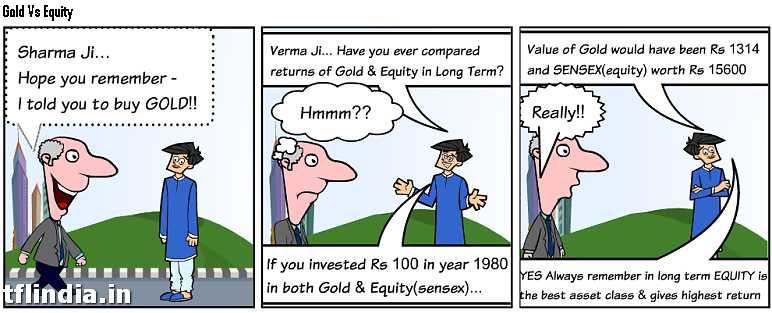
From 2010 to 2026, gold in India rose from approximately Rs 18,000/10g to Rs 90,000/10g – roughly 5x in 16 years, approximately 11-12% CAGR. Sensex over the same period: approximately 20,000 to 75,000 – 3.75x in price, but including dividends reinvested approximately 4.5-5x. Similar headline returns.
But over a longer 50-year horizon (1975-2025), gold’s CAGR in India has been approximately 9-10%. Equity (Sensex) CAGR over the same 50 years: approximately 14-15%. The difference of 4-5% per year, compounded over 25 years, is the difference between a Rs 50L retirement corpus and a Rs 1.5-2 crore retirement corpus.
The recent 2020-2024 gold bull run was driven by exceptional factors: global COVID uncertainty, US dollar weakness, and geopolitical tensions. These factors will not persist indefinitely. Investors who extrapolate the last 4-year return into a 25-year plan are making a textbook behavioural error.
The Right Role for Gold in a Retirement Portfolio
Gold is not useless. It has genuine properties that make it valuable as a portfolio component. It tends to rise when equity falls sharply (negative correlation in crisis periods). It holds purchasing power over very long periods. It provides genuine insurance against extreme tail-risk events – currency crises, geopolitical disruptions, systemic financial failures.
The correct allocation for most Indian retirement portfolios: 5-10% in gold. No more. This gives you the insurance and diversification benefits without sacrificing the superior long-run return potential of equity.
And the vehicle matters enormously. Physical gold has making charges of 8-25%, storage costs, theft risk, and capital gains tax. Gold ETFs are more efficient but still have capital gains tax. Sovereign Gold Bonds (SGBs) give you gold price exposure, a 2.5% annual interest income, AND tax-free capital gains if held to 8-year maturity. For a retirement portfolio, SGBs are the clear winner – but new issuances have been paused since 2024. Secondary market purchases at NSE/BSE are still possible.
5% gold allocation as insurance is wisdom. 40% gold allocation because it went up is speculation.
At RetireWise, we build asset allocations designed for retirement – with the right role for every asset. SEBI Registered. Fee-only.
Why Indians Cannot Let Go of Physical Gold
India holds an estimated 25,000+ tonnes of private gold – the largest private gold hoard in the world. This figure has barely changed as a proportion of savings despite decades of financial education. There are genuine cultural and emotional reasons for this that deserve respect – gold as family wealth, gold as marriage asset, gold as the one form of savings that families trust across generations.
But behavioural economists identify two specific biases that explain why rational investors also over-allocate to physical gold beyond what makes financial sense.
The first is the Endowment Effect (Kahneman, Knetsch & Thaler, 1990): gold that is already owned feels more valuable than its market price. The thought of selling ancestral gold to invest in mutual funds – even when the numbers clearly favour doing so – creates a disproportionate sense of loss. The gold feels priceless. The mutual fund feels uncertain.
The second is Loss Aversion: the fear of selling gold and missing a future price rise feels more painful than the certainty of suboptimal long-term returns from holding it. So the gold sits. Year after year. Earning nothing. While inflation steadily reduces its purchasing power in real terms.
The combination keeps Indian households severely over-allocated to physical gold and under-allocated to equity – exactly the opposite of what long-term wealth creation requires.
“Gold should be small part of your asset allocation. And the reason for buying it should not be because the price has risen. When everyone says the price will only go higher – that is exactly when you should keep your head cool.”
– Hemant Beniwal, CFP, CTEP | Founder, RetireWise
Read next: Holding Period and Investment Risk – What 38 Years of Sensex Data Actually Shows
What percentage of your retirement savings is in gold? Most people are surprised when they calculate it honestly.
RetireWise builds retirement portfolios for senior executives with the right balance of equity, debt, and gold. SEBI Registered. Fee-only.
When gold was at Rs 28,000 in 2017, my inbox was quiet. When it crossed Rs 90,000 in 2024, the inbox flooded again. The investors who bought in 2017 made money. The investors who called me in 2024 asking whether to increase their allocation – most of them were already too late for the bulk of the move. The crowd and the right time are almost never in the same place. Keep your head cool before taking investment decisions. That advice from 2010 has not aged a day.
Buy gold for the right reason – insurance and diversification. Not because everyone says the price will only go higher.
💬 Your Turn
If you added up all physical gold, gold ETFs, and SGBs in your household – what percentage of your total financial assets is in gold? Is that allocation a deliberate strategy, or something that just accumulated over the years?
There is no doubt that the return in the equity could be more then return on gold. Perhaps it is also true that probability of getting return is more in case of gold then in equity. The author him self has given many examples in which the person has invested in equity (for trends, decision on past performance or what ever reason) and has not able to get the expected return. It was expected from the author to gave some examples in his article where the investor has invested in gold but did not get the expected return. If the equity is that secure assets the the nations would have maintained the portfolio instead of gold reserve to support there currency. The principle apply to nations apply to individuals also but rule of more risk more gain will always prevails.
Hi Piyush,
Thanks for sharing your views – I think it’s your first comment.
It looks you have good insight over investments – I keep saying “good investment don’t generate good returns, it’s investor behavior that makes the difference.” I am writing a cover story for one of the personal finance magazine on this topic.
You can get rest of the answers in this article
https://www.retirewise.in/2010/07/should-indians-buy-gold-now.html
Keep sharing you views.
Comments are closed.