
Last Updated on August 25, 2026 by Hemant Beniwal
Not long ago I spoke with a gentleman in his late 60s who was starting to plan his move back to India after decades of working abroad. He was thoughtful, successful, and completely sensible. Over the years he had built a substantial corpus, and he had kept almost all of it, some 80 to 85 percent, in bank deposits. Not out of ignorance. Out of a deep, deliberate preference for safety. In his own words, he did not want to lose sleep. His emotional need was simply to be in the safest possible place.
I understood him completely, because he is not unusual. He is, in fact, one of the most common and most admirable kinds of people I meet. Careful. Disciplined. Allergic to unnecessary risk. He had done everything the prudent way for thirty years.
And yet, as we talked, a quiet problem came into view. His money was safe. His retirement might not be. Because the one risk he had never guarded against was not a market risk. It was time.
⚡ Quick Answer
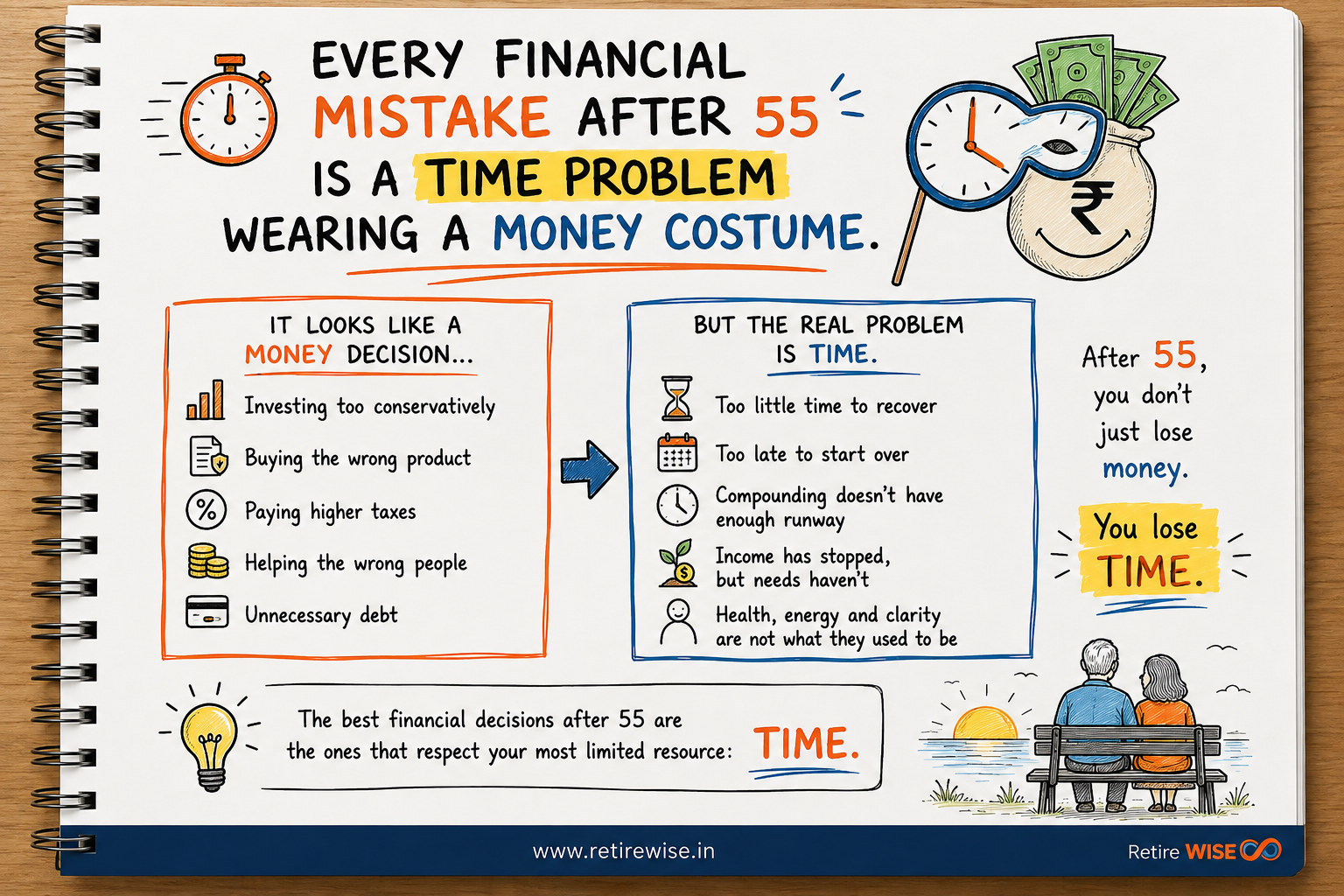
After 55, the real cost of a financial mistake is rarely the rupees lost. It is the years you no longer have to recover them. That is why both extremes, being too cautious and being too aggressive, are really the same problem in disguise: a time problem wearing a money costume. The safest-feeling choice and the safe choice are not always the same thing. The decisions that serve you best after 55 are the ones that respect your most limited resource, which is no longer money. It is time.
The Three Resources, and the One You Cannot Rebuild
By the time you cross 55, you are managing three resources at once, not one. Money, health, and time. We spend almost all our worry on the first, because it is the one we can see, count and control. But here is the quiet truth that reframes everything. Money is the only one of the three you can still rebuild. Health and time, you cannot.
This is precisely why the careful gentleman’s caution, so wise for so long, can quietly turn into a trap in retirement. A corpus that never grows faster than inflation is not truly safe, it is simply losing its purchasing power slowly enough that no one notices until much later. Zero equity in retirement is its own kind of risk, one that does not show up on day one, and I have written separately about why the safest-looking portfolio can be the most vulnerable over a thirty-year horizon. His mistake, if he makes it, will never appear on any statement. It will show up instead, fifteen years from now, as the trips quietly not taken and the withdrawals gently cut, in the years when he can least adjust.
Why the Runway Runs Out
Think of it like an aircraft on a runway. At 35, a financial mistake is like missing your exit on a long highway. Annoying, but you have miles of road ahead to correct it. Your salary keeps flowing, your investments have decades to recover, and time repairs almost everything.
At 68, the same mistake is like running out of runway. You can still change direction, you can still adjust the controls, but there is very little room left for error, and no salary coming in behind you to buy back what you lose. The mistake is identical. What has changed is the time available to survive it. That, in one image, is the whole of it. After 55, every financial decision should be weighed not by how much it might cost, but by how long it would take to recover if it went wrong. It is worth remembering that inflation is the quiet thief that never announces itself, working against that shrinking runway every single year you are not looking.
Both Extremes Are the Same Mistake
Here is what makes this lens so useful. It explains the opposite error just as well.
The overly cautious retiree loses slowly, to inflation, over decades. But the retiree who swings too hard the other way, chasing high returns late in life or taking a large, concentrated bet in the hope of catching up, faces the same underlying problem from the other direction. If that bet goes wrong at 65, there is no runway to recover it, no fresh income to rebuild with, and the loss can be permanent in a way it never would have been at 35. Almost always, that reach for a big late gain is fear wearing the mask of ambition, the fear of not having enough pushing people toward exactly the risk that can leave them with far less. Too safe and too risky look like opposite mistakes. They are not. They are the same mistake, seen from two sides, and the common thread is time. One spends it slowly, the other gambles it all at once, and neither can be undone once the runway is behind you.
The Most Expensive Mistake of All
Which brings us to the error almost nobody names, and the one I see most often. Delay.
Before 55, procrastination is forgivable, because time absorbs it. In fact, delaying retirement planning even in your 40s already costs you more than you think. After 55, delay becomes the single most expensive decision you can make, because putting off a choice does not pause the clock. It spends the one resource you can never refill. Every year spent waiting to fix an allocation, waiting to build a proper withdrawal plan, waiting to have the difficult conversation, is a year subtracted from a runway that was already short. After 55, doing nothing is not a neutral choice. It is the most costly action available to you, precisely because it feels like no action at all.
The Turn Worth Making
The good news is that this gentleman, careful as he was, had already begun to see it for himself by the end of our conversation. He noticed that money he would never even withdraw was still being taxed every year, quietly draining. He wondered aloud whether investments taxed only when needed might serve him better. He recognised that the portion of his corpus meant for his children ought to follow their long time horizon, not his own fear. Interestingly, the opposite problem is just as common, people who have saved enough and still cannot bring themselves to spend it, frozen by the same instinct that keeps everything locked away in the name of safety.
That is the whole shift. Not to abandon prudence, which served him well, but to recognise that after 55, prudence itself must be measured in years, not just in rupees. The safest place for your money and the safest choice for your retirement are sometimes two different things, and only the calendar can tell you which is which.
After 55 you do not just lose money when a decision goes wrong. You lose time, and time is the one thing no return, however high, can ever pay back.
Do not only ask how much a mistake will cost you. Ask how many years it will take to recover from, and be honest about how many you have.
Weighing a Decision With Little Time to Spare?
After 55, the right choice depends as much on your remaining runway as on the numbers themselves. If you want a considered second pair of eyes before you decide, I am happy to think it through with you.
💬 Your Turn
Is there a financial decision you have been putting off, telling yourself there is still time? Share it in the comments below. Sometimes naming it is the first step to acting on it.