
Last Updated on July 20, 2026 by Hemant Beniwal
This may sound a little unusual, but one of the first things I showed my wife on the night we got married was not our photo album. It was my mother’s household diaries.
For decades, she recorded every single expense by hand, from the weekly loaf of bread to the monthly milk bill. My father passed away when I was just two years old, and my mother became the family’s sole earning member. Resources were limited, but she taught my sister and me something that no salary can buy. Financial success is not determined by income alone. It is determined by discipline.
Those handwritten diaries funded dreams that many people around us thought were impossible. My sister completed her MBA from one of India’s top business schools. I proudly rode one of the first Bajaj Pulsars in Jaipur, which was the machine every college boy in those days quietly dreamed about. My sister had a beautiful destination wedding at a five-star resort. All of it, without a single loan and without financial help from relatives. I had seen the same habit in my grandfather, who kept meticulous records while our family home was being built. So when I married, I asked my wife to continue the tradition, and thankfully she still keeps it today.
⚡ Quick Answer
Inflation is the one retirement risk that hurts you most after you stop earning. While you are working, salary increases quietly shield you from rising prices. The day you retire, that shield disappears, but the prices keep climbing. Your income becomes fixed while your cost of living does not. Worse, a retiree’s personal inflation usually runs higher than the official figure, because the things retirees spend most on tend to rise fastest. This is about seeing the quiet thief clearly, and planning so it never catches you.
The Diaries Tell Another Story
Looking back through those pages now, they tell a second story my mother never intended to write. They are a four-decade old records of inflation, in her own handwriting.
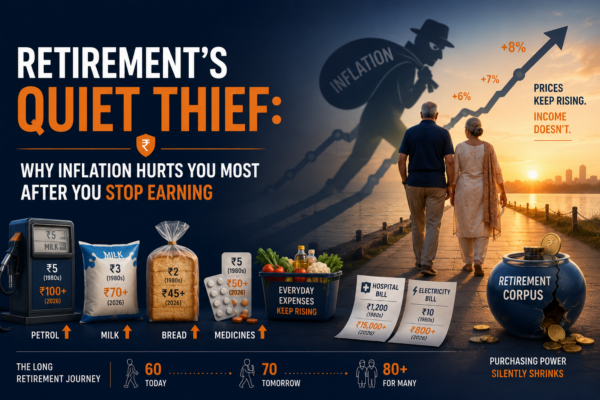
A loaf of bread that cost around two rupees in the 1980s now costs over forty-five. Petrol has climbed from roughly five rupees a litre to more than a hundred. Milk has gone from about three rupees to nearly seventy. Put simply, one rupee from 1980 has the purchasing power of only about twenty-five rupees today. The same rupee that once bought a full meal now barely buys a spoonful.
That is inflation at work. It is the quiet thief. It does not announce itself the way a market crash does. There is no headline, no dramatic fall, no moment you can point to. It simply takes a little every year, so slowly that you never feel the theft on any single day, until you look back across decades and realise how much has quietly gone.
Why It Hurts Most After You Stop Earning
Here is the part most people underestimate. For your entire working life, you are protected from inflation without ever thinking about it. Prices rise, but so does your salary. The increment, the promotion, the job change, all of it keeps rough pace with the rising cost of living. You feel the pinch, but you are never truly exposed.
Then you retire, and that protection vanishes overnight. Your expenses carry on climbing exactly as before, but your income no longer rises to meet them. For the first time in your adult life, you are standing in front of the thief with no shield. A retirement that begins comfortably at 60 can feel surprisingly tight at 75, not because anything went wrong, but because the quiet thief simply kept working while your income stood still. This is why the fear of money slowly running out is one of the most common and most rational worries I hear from people approaching retirement.
Your Inflation Is Not the Government’s Inflation
There is a deeper trap hidden inside all of this, and it is the one that quietly undoes even careful plans. The official inflation figure is an average across a broad basket of goods, much of which a retiree does not actually buy. Your personal inflation, the rate that applies to your real life, is usually higher.
Look at what has actually happened over the last twenty-five years or so. Milk has roughly quintupled. Petrol has climbed close to fourfold. Gold has multiplied many times over. And the categories a retiree leans on most heavily, healthcare, medicines, domestic help, private hospital rooms, have risen far faster than the gentle headline number suggests. Medical costs alone have been running at two to three times general inflation. The official figure is held down by things you may no longer spend much on. Your real basket, full of exactly the items rising fastest, runs hot. Planning your retirement on the headline inflation number is planning for a life you will not actually be living.
What a Comfortable Life Costs Later
Let me show you what this means in rupees, because the compounding is genuinely hard to feel until you see it laid out. Imagine your household runs comfortably on one lakh rupees a month today. Here is what that very same lifestyle costs in the years ahead, first at a modest six percent, and then at the eight percent that is closer to a real retiree’s basket.
| The same ₹1 lakh lifestyle | At 6% (headline) | At 8% (real basket) |
|---|---|---|
| Today | ₹1,00,000 | ₹1,00,000 |
| In 10 years | ₹1,79,000 | ₹2,16,000 |
| In 20 years | ₹3,21,000 | ₹4,66,000 |
| In 30 years | ₹5,74,000 | ₹10,06,000 |
Illustrative, based on steady 6% and 8% annual inflation. The point is the direction, not the decimal.
Read that last row slowly. A person who retires at 55 and lives to 85, which is increasingly common, may need close to ten lakh rupees a month to fund the very same life that one lakh buys today. Not a grander life. The identical one. That is not a market risk you can wait out. It is a certainty you must plan for.
Why the Corpus Feels Impossibly Large
This is also why so many people, especially younger investors, look at the retirement figure I show them and simply refuse to believe it. The number feels unreal, almost absurd. So I ask them a simple question. What was your father’s salary in his very first year of work, and what are his annual expenses in retirement today? The gap between those two numbers is enormous, and almost all of it is inflation, silently compounding across a single lifetime. Once they see it in their own family, the large corpus stops feeling absurd and starts feeling necessary.
The Trap of the Safe Corpus
Faced with all this, many retirees do something that feels prudent but quietly does the most damage. They move everything into fixed deposits and so-called safe instruments, relieved to be shielded from market ups and downs. But safe from a market fall is not the same as safe from inflation. A market correction usually recovers within a few years. Purchasing power lost to inflation, year after year, almost never comes back on its own.
The uncomfortable truth is that a fixed corpus is not a safe corpus. If your money is not growing at least as fast as your personal cost of living, it is shrinking in real terms every single day, no matter how large the number in the account looks. Protecting a retirement from inflation means allowing part of it to keep growing, gently and sensibly, long after the salary has stopped. How you draw an income from that corpus matters just as much as how large it was on the day you retired.
Living With the Thief
You cannot defeat inflation. No one can. But you can stop it from robbing you blind. You plan around it, by building a corpus that assumes rising costs rather than today’s costs, by keeping part of your money growing through retirement, and by revisiting the plan honestly every few years rather than setting it once and hoping. The goal is not to fear the thief. It is to know it is in the room, and to plan so calmly and so well that it never actually takes anything that matters.
My wife still keeps the diary, all these years later. Different prices now, the same discipline. And when I look at those numbers next to my mother’s from four decades ago, I do not feel anxious. I feel prepared, because I can see exactly what the thief has been doing, and I have planned for it to keep right on doing it.
A market crash makes the headlines and then recovers. Inflation makes no noise at all, and never gives the money back.
The quiet thief does not steal your money. It steals what your money can buy.
Is Your Plan Built for Today’s Prices or Tomorrow’s?
A retirement plan that ignores inflation is planning for a life you will not be living. If you want to see what your own numbers look like once the quiet thief is accounted for, I am happy to work through it with you.
💬 Your Turn
Do you remember what something cost when you started working, against what it costs today? Share the price that surprises you most in the comments below. I read every one.